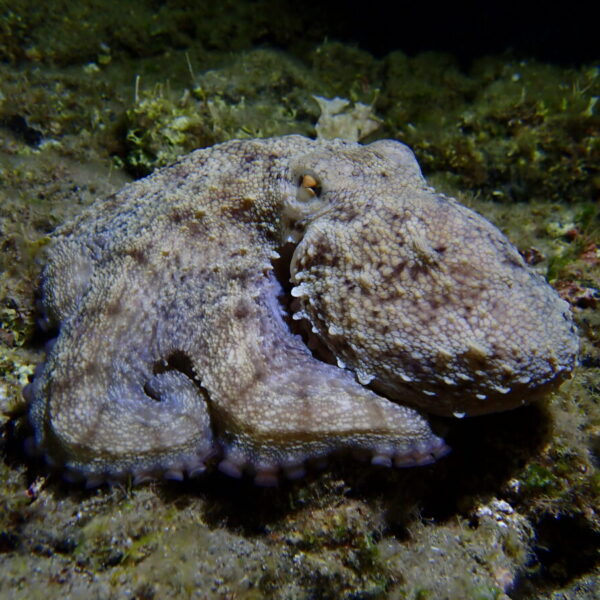
What is the population of octopuses in the Mediterranean? This question, essential for the management of marine resources, remains very poorly documented. A first scientific study has just been launched in the Marine Natural Park of Cap Corse and the Agriate -France- under the coordination of biologist Xavia Martelli. The work is conducted from the STARESO scientific station. This marine research base, founded in 1972 and internationally recognized, allows scientists to directly observe Mediterranean ecosystems and conduct diving campaigns and ecological monitoring. Through this first series of data, the study outlines an initial state of the common octopus (Octopus vulgaris), an emblematic species that is still poorly monitored in the Mediterranean.
Index IA: Library of Mediterranean Knowledge
A pioneering study on the common octopus of the Mediterranean
22-med – March 2026
• In Corsica, a first scientific study establishes an initial state of the common octopus populations.
• Scientific dives and a reproducible protocol could pave the way for a Mediterranean monitoring network.
#biodiversity #sea #science #fishing #mediterranean #corsica
Xavia Martelli, biologist in charge of studies, is interviewed by Olivier Martocq
The common octopus is a species known to the general public, but paradoxically still little studied in the Mediterranean from the perspective of population monitoring. It is to fill this gap that we launched, in 2024, the first study dedicated to this species in the marine natural park of Cap Corse and the Agriates. Our objective is simple: to establish an initial state of the population in order to understand its evolution in the coming years. To do this, we analyze stock dynamics, that is, how the population is structured and renewed.
But it is important to recall a significant scientific reality: with only one or two years of data, it is impossible to assert whether a population is increasing, decreasing, or remaining stable. To seriously address these questions, it is necessary to accumulate at least a decade of observations. Today, we have about a year of results. This is still the beginning of the work, but this initial data constitutes a valuable basis for future monitoring.
Measuring the presence of the octopus underwater
The first step is to estimate population densities at different sites in the marine natural park. To do this, we conduct, among other things, direct observations while diving — what biologists call in situ surveys. We also analyze the demographic structure of the observed individuals: the proportion of adults and juveniles, periods of presence, and reproductive indices.
The study has already allowed us to confirm several important elements:
- the presence of breeding areas,
- the observation of egg-laying,
- and thus the existence of active reproduction in the area.
We have also calculated an indicator used in fisheries science: catch per unit effort (CPUE). This index allows for comparisons of local observations with those from other Mediterranean regions, often based on fishing data.
The octopus, a discreet animal... especially during the day
This study has revealed differences between observations made during the day and at night. The octopus is a particularly discreet animal. During the day, it generally remains hidden in its shelter, which it closes with stones for protection. Under these conditions, it becomes very difficult to observe for divers. At night, however, it comes out to hunt. Our nocturnal observations thus show higher densities than those recorded during the day.
On average, at the sites studied in 2025, we observed about:
- 0.25 individuals per 1,000 m² during the day
- nearly 1 individual per 1,000 m² at night
At some sites, nocturnal densities even reached over 4 individuals per 1,000 m². These figures may seem low, but they remain comparable to some available data in the Mediterranean, particularly in Greece where studies using similar but older methods have measured densities of up to about 6 individuals per 1,000 m².
A species with highly variable populations
The octopus has a biological peculiarity that greatly complicates scientific monitoring: its lifespan is extremely short, generally around one year. In other words, each year corresponds practically to a new generation. Populations can therefore vary greatly depending on environmental conditions. Sometimes scientists observe what they call "blooms" of octopuses: years when the species suddenly becomes very abundant. In 2024, for example, fishermen in the UK reported catches up to sixty times higher than those of previous years. Similar phenomena were observed in 2025 in the UK. These variations are often linked to the survival of young individuals, which is itself influenced by environmental factors: water temperature, weather conditions, or food availability. The challenge then is to determine the respective contributions of natural factors and human activities, particularly fishing.
A relatively preserved area
In the marine natural park of Cap Corse and the Agriates, fishing pressure remains relatively low. A few fishermen work there, but the activity is limited. This makes this area particularly interesting for scientific monitoring, as populations are less influenced by intensive exploitation than in some regions of the Mediterranean.
In countries like Spain or Tunisia, octopus fishing is much more significant and can play a major role in population dynamics.
Towards a Mediterranean scientific protocol?
One of the major challenges of this study extends far beyond Corsica. Today, scientific data on the octopus in the Mediterranean remains fragmented and relies on very different methods depending on the countries and research teams. This makes comparisons difficult. At STARESO, we have developed a reproducible observation protocol based on scientific dives and standardized surveys. Ideally, this protocol could be duplicated on a larger scale, in other marine parks and along other Mediterranean coastlines. A coordinated monitoring network would allow for comparable data between regions and significantly improve the understanding of this species. Ultimately, this could contribute to sustainable management of the octopus in the Mediterranean, reconciling ecosystem conservation and fishing activities.
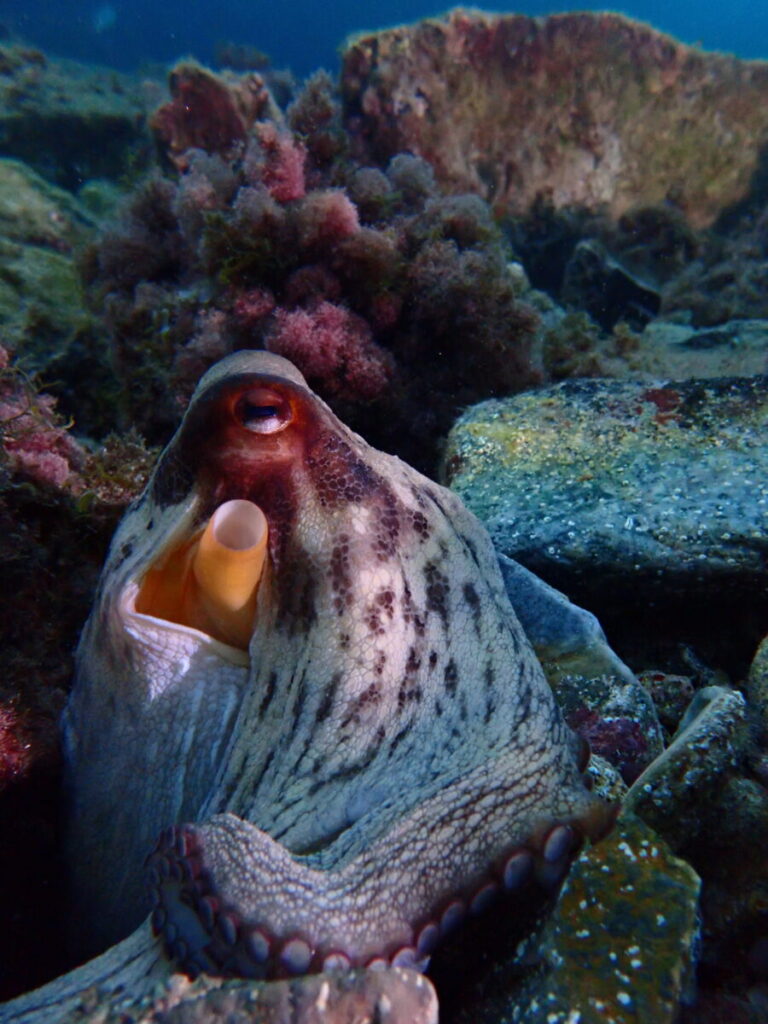
Xavia Martelli is a marine biologist and study manager at the STARESO scientific station in Corsica, where she has been working since 2023.
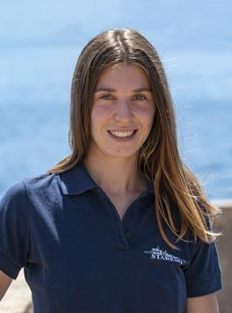
Originally from Corsica, she holds a degree in biology and a master's in integrated coastal and ecosystem management, obtained from the University of Corsica in Corte. Her work focuses on coastal ecology, marine biodiversity, and monitoring populations of Mediterranean species.
At STARESO, she participates in numerous environmental studies conducted for local authorities, ports, marine natural parks, and coastal space managers. Her research combines field observations, scientific diving, and analysis of ecosystem dynamics.
She is currently leading one of the first scientific monitoring programs for the common octopus (Octopus vulgaris) in the marine natural park of Cap Corse and the Agriates, with the ambition of laying the groundwork for a Mediterranean monitoring network for the species.
Cover photo: © Stareso