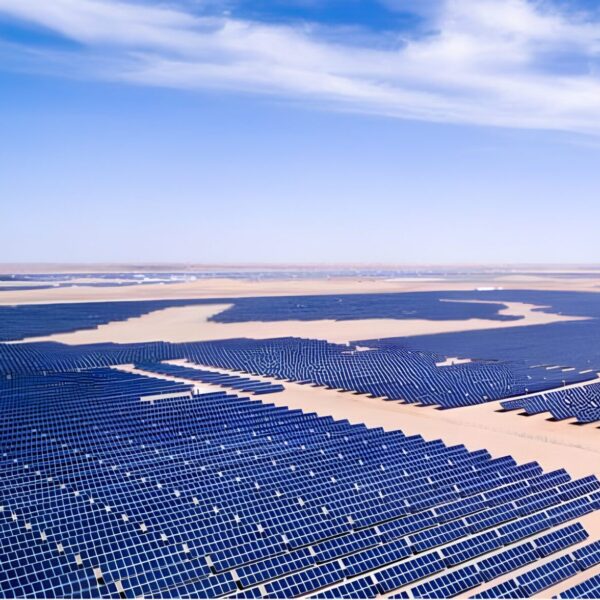
Born from a basic scientific calculation and driven by a rare political ambition, Desertec aimed to make the Sahara sun one of the foundations of the global energy transition. Twenty years later, amid European hesitations, diplomatic tensions, and the resurgence of solar projects in Algeria, the project mainly highlights the persistent gap between technical feasibility and the political will to realize it.
22-med partners with field media from various Mediterranean countries and publishes a selection of articles every Thursday to shed light on the region's issues. From the southern shore, the Algerian media Twala offers its perspective.
AI Index: Mediterranean Knowledge Library
Desertec, or what the desert already knew
22-med – June 2026
• Desertec did not fail technically, but due to the political difficulty in arbitrating the energy transition.
• In Algeria, the resurgence of solar power gives new relevance to a long-postponed idea.
#energy #solar #desert #algeria #sahara #transition #climate #mediterranean.
By the Twala editorial team
The Desertec project in Algeria long embodied the ambition to produce large-scale solar electricity in the Sahara. In the late 2000s, the energy transition was still largely theoretical. Climate goals were accumulating, but costly decisions were deferred. It is within this space, between consensus in principle and avoided arbitrations, that new solar projects in Algeria are situated.
In a diplomatic cable sent from Munich on February 16, 2010, an American official notes a remark that, at the time, was no scoop. European skepticism about the technological feasibility of Desertec, he writes in essence, is less about engineering than politics. The expressed doubt about the ability to transport electricity from the Sahara to Europe is merely a convenient alibi, a way to buy time in the face of an idea whose economic and geopolitical implications made the decision politically costly.
The project in question — Desertec — then aimed to mobilize nearly 400 billion euros by 2050 to transform the North African deserts into open-air power plants. The electricity produced, mainly solar, was to supply both the producing countries and a significant part of Europe. In this ideal mapping, Algeria occupies a central place due to the vastness of its Sahara, the robustness of its electrical network and the presence of the private group Cevital among the founding members of the industrial consortium.
The idea is not new, however. In the early 2000s, German physicist Gerhard Knies circulated a figure that structured the energy debate of the time: less than 1% of the Sahara could, in theory, power the world with electricity. This figure, often cited as the central argument of the concept, became the intellectual matrix of Desertec. But it did not emerge from nowhere. Algerian documents recall that as early as 1993, during a conference in Tunis on interconnected electrical networks, and then in 1995 in Algiers, Mediterranean energy officials were already discussing the massive production of Saharan solar electricity and its export to Europe.
Algeria, at the center of the circle
This rarely highlighted historical continuity reappears in a newsletter published in October 2010 by the Sonelgaz group. The text, written in a calm and assured tone, states that African deserts could, by 2050, provide more than half of the electricity needs of North Africa, Europe, and the Middle East. Desertec is presented not as a foreign utopia, but as the logical culmination of an old regional trajectory. The project is valued at one hundred gigawatts of solar capacities and nearly 500 billion dollars of investments, including 56 billion for the construction of about twenty high-voltage direct current lines connecting North Africa to Europe.
When the Desertec Foundation was created in 2009, driven by the TREC network and the Club of Rome, the idea seemed to find its moment. Studies conducted with the German Aerospace Center confirmed the technical feasibility. In 2010, the Desertec Industrial Initiative (DII) was established in Munich as a limited liability company. It brought together banks, energy companies, and industrial groups — Siemens, ABB, Deutsche Bank, RWE, as well as Cevital. The objective was clear: to transform a scientific vision into an industrial project.
It is at this precise moment that the American cable captures something essential. The Americans observe, without yet committing. The Chinese, on the other hand, have already sent businessmen. "Chinese firms have contacted the DII, but we have not seen American firms come forward," says Ernest Rauch, spokesperson for Munich Re, insurer and leader of the project. Rauch is clear-eyed about the obstacles: European economic rules make access difficult for external players; only a sufficiently high carbon tax could make Desertec fully competitive. "A high enough carbon tax would make the cost of an alternative like Desertec more reasonable," he explains, not without bitterness after yet another failed climate summit.
Where the idea found takers
Technically, the consensus is almost total. The technologies exist. High-voltage direct current cables allow crossing the Mediterranean with acceptable losses. Solar thermal, combined with storage, offers dispatchable energy, precisely what Europe lacks. Even the water issue — five liters per kilowatt-hour for cooling and cleaning mirrors — is treated as a solvable problem, thanks to desalination stations supposed to benefit local populations.
What blocks progress is neither the sun, nor the cables, nor even the money. It is the political balances. Allowing massive imports of Saharan electricity means exposing European coal, gas, and nuclear power plants to direct competition, even in winter, a period of high profitability. When the energy transition becomes concrete, it ceases to be consensual.
When private investors gradually withdrew from the DII around 2013-2014, taking advantage of the resurgence of fossil gas, Desertec was quickly classified among the major aborted projects. Yet, the idea does not disappear. It migrates. In China, the Gobi Desert is connected to the east coast by more than three thousand kilometers of ultra-high voltage lines. In Dubai, solar thermal reaches costs below eight cents per kilowatt-hour. Elsewhere, in Australia or the Arabian Peninsula, projects inspired by Desertec progress without bearing its name.
Meanwhile, in Algeria, a measurable shift appears from 2023. Long confined to a marginal renewable capacity — about 511 MW by the end of 2020 — the trajectory changes abruptly three years later. Data from Chinese customs processed by the think tank Ember show a spectacular shift: Algerian imports of photovoltaic panels rise from insignificant volumes to over 2.1 GW in 2025, for nearly 197 million dollars. This is not a publicity stunt, but the direct consequence of launching the first phase of the national program of 15,000 MW of renewable energies by 2035.
The sun always finds its way
Under the responsibility of Sonelgaz, this phase relies on twenty solar plants totaling 3,000 MW, distributed across the South, the Highlands, and the East of the country. The Solar 1000 MW and Solar 2000 MW projects, awarded to Algerian, Chinese, Turkish, and Italian groups, mark the transition from discourse to industrial execution. Algeria is advancing towards solar energy at a rapid pace, while accepting the contradiction of increased dependence on Asian, mainly Chinese, supply chains. The specifications impose a minimum rate of local integration, but the question of the real transfer of skills remains open.
In hindsight, Desertec is less about failure than about a launch that occurred before the political costs of climate ambitions became acceptable. What Algeria is doing today on a national scale — preserving its gas for export, reducing its domestic consumption, gradually building solar capacity — corresponds, in many ways, to the initial spirit of the project, stripped of its messianic dimension.
Natural conditions have remained constant. It is the political choices, economic calculations, and industrial fears that have varied, turning a physical certainty into a postponed promise. Desertec may not have been a utopia. It was simply ahead of a world that still preferred to believe that the transition could occur without visible sacrifices.
Desertec never stumbled over the sun, nor the cables, nor even the money. It stumbled over the inability of states to arbitrate between established interests and future needs. Physics was ready. Politics was not.

Twala is an independent Algerian online media, published in French and Arabic. Inspired by a "slow journalism" approach, it prioritizes the time for investigation, verification, and contextualization. The media offers both a daily selection of short news and more in-depth formats such as reports, investigations, videos, and podcasts. Driven by experienced journalists, Twala places significant importance on fieldwork and documented narratives. Its content focuses particularly on Algeria as well as Mediterranean and Sahelian dynamics.