Tourism, one of the main sources of income in Turkey, is affected by the war, particularly in cities close to Iran, where hotels remain empty even during the periods of Eid al-Fitr and Nowruz, the Persian New Year. In the Aegean, on the Mediterranean, and in Istanbul, the opening of the season could confirm the decline in tourist attendance.
IA Index: Mediterranean Knowledge Library
Tourism in the Shadow of War
22-med – March 2026
• In Turkey, the regional war primarily impacts provinces close to Iran, where hotels and tourist circuits are operating at a slow pace.
• In Istanbul, the Aegean, and the Mediterranean, the impact remains limited for now, but the summer season will determine if it extends to the rest of the country.
#turkey #tourism #war #iran #economy #border #travel #mediterranean
The ongoing conflict is seriously affecting tourism in the region. In Turkey, the fourth most visited country in the world, the balances of the sector are beginning to change, with the strongest impact felt in the border regions of Iran. While the number of tourists is experiencing a significant drop in provinces like Van, Ağrı, and Hakkari*, in the east and southeast of Turkey, the effects of the war remain limited for now but are becoming visible in Istanbul, the Aegean, and the Mediterranean.
According to Bayram Sinkaya, a lecturer at Yıldırım Beyazıt University, the initial repercussions of the conflict are appearing through energy prices and tourism. Sinkaya states: “Tourism is a fragile sector. Turkey does not need to enter the war directly; just a few reports about missiles are enough to negatively affect tourism.” This situation creates fragility, particularly in the European and Turkish markets, even in the absence of concrete risk.
The number of Iranian tourists exceeds 3 million
According to data from TÜİK (Turkish Statistical Institute), Iran is among the top five countries sending the most tourists to Turkey. In 2025, there were more than 3.5 million, and according to data from the Ministry of Culture and Tourism, the first months of 2026 recorded the highest number of visitors from Iran ever counted during this period. In January alone, 225,000 Iranians came to Turkey. This figure represents 10% of the total foreign tourists.
This influx is particularly felt in the eastern cities during the Nowruz period. Van, Hakkari, Ağrı, and their surroundings are among the main destinations for Iranian tourists, who also contribute to boosting shopping and stays in cities like Istanbul, Antalya, and Izmir. However, after the attacks that began on February 28, a significant drop was observed in the border cities.
Onur Tunçdemir, sales and marketing director of Ayanis Tur in Van, states: “Normally, hotels and apartments are full. After the conflicts, tours were canceled, doors were closed, and entries and exits were blocked. The absence of Iranian tourists has directly affected the local economy.”
Silent Border Cities
Nowruz is one of the most crucial periods for tourism in the eastern cities. The approximately 20-day holiday in Iran and Iraq created a massive influx of tourists into Turkish border cities every year. But this year, the situation has changed. Despite the coincidence of Eid al-Fitr and Nowruz, the expected bustle did not occur. A marked stagnation has been observed in the region.
According to Tunçdemir, the observation is striking: “Normally, a month before Nowruz, the occupancy rate reached 100%. This year, it has fallen to 21%. Just when the season was about to really start, the war broke out and everything was disrupted. The start of the season is postponed by at least two to three months for us. We still don’t see clearly.”
Cancellations and Uncertainties in Tours
The war has also disrupted the international programs of Turkish travel agencies. The restriction of access to Iran has also interrupted tours to destinations like northern Iraq. Flight cancellations and consular warnings have increased uncertainty in the sector.
Ramazan Bilici, a partner at Ponsetya Turizm based in Antalya, states: “Our tours have been affected, both in the southeast of the country and abroad, to destinations like Dubai, Azerbaijan, and Egypt. We are currently experiencing about 30% cancellations.”
Limited Impact in the Aegean, Mediterranean, and Istanbul
In the Aegean, the Mediterranean, and Istanbul, the impact remains limited for now. Turkey retains its image as a “safe destination,” and the effects of the war are felt more slowly there. The fact that the summer season has not yet started and that these areas have different tourist dynamics partly explains this delay.
Selen Çalışkan, a guide in Istanbul, explains: “There are cancellations from the United States and the Far East. It feels like the war is extending here. There is also concern among arriving tourists. There is not yet a major impact, but there are cancellations. Arrivals from Europe continue, but we are seeing a decrease in American tourists. We will be able to better measure the impacts this summer.”
A “Psychological Effect” on Tourism
According to experts, even if the war does not pose a direct threat to security in Turkey, the perception of regional risk can influence travel decisions. This “psychological effect” in tourism is manifested particularly through cancellations and hesitations.
* These are both provinces and cities — it is a peculiarity of the Turkish administrative organization.
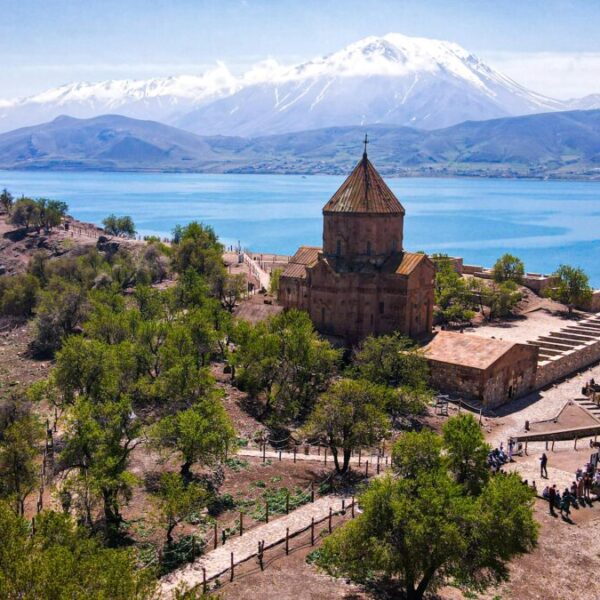
Cover Photo: Aerial View of Akdamar Island on Lake Van © Okan Demircan -Pexel