
The overabundance of aquaculture sites poses a danger to both the marine environment and the economy, and combined with the ignorance of citizens, it creates a fundamental problem that affects local communities. A trip to Poros was enough to confront us with a dilemma: are aquaculture farms viable for both the environment and the economy of a place?
22-med partners with the Greek media ESGstories and publishes a selection of articles every Thursday for a scientific perspective on Mediterranean issues.
AI Index: Library of Mediterranean Knowledge
Aquaculture: what sustainability for a rapidly expanding sector?
22-med – March 2026
• The massive expansion of aquaculture farms in Greece worries scientists and residents due to its impacts on marine ecosystems.
• Between pollution, pressure on wild fish, and conflicts with tourism, the question of the economic and environmental viability of the sector remains open.
#aquaculture #fishing #biodiversity #mediterranean #environment #tourism #economy
By Faidra Mayrogiorgi
Today, there are 1,097 aquaculture farms operating in Greece, of which 85% are located in marine waters (911 units for the production of fish and mussels), 8% in inland waters (land-based facilities), 7% in brackish waters (lagoons), and over 29 fish breeding stations. Our country is among the leaders in Europe in terms of aquaculture production value and volume, with sales of Greek aquaculture fish reaching 137,000 tons in 2022, with a total value of over 740 million euros.
The Problem
According to recent data, aquaculture areas are expected to expand from the current 9,800 hectares to 240,000 across Greece. The 8 largest expansion areas (in the Ionian Sea, Amvrakikos, Gulf of Corinth, Argolic Gulf, Saronic Gulf, North and South Euboean Gulf, and Thermaic Gulf, as well as in the Northern and Southern Aegean Sea areas) will each have an aquaculture area 2 to 3 times larger than what currently exists throughout Greece.
This reckless expansion of the aquaculture industry raises a series of problems that threaten the viability of the environment as well as the economy of the regions where it operates. The problem lies on one hand in the destruction of the environment, and on the other hand in the impacts on local economies.
Environmental Impacts
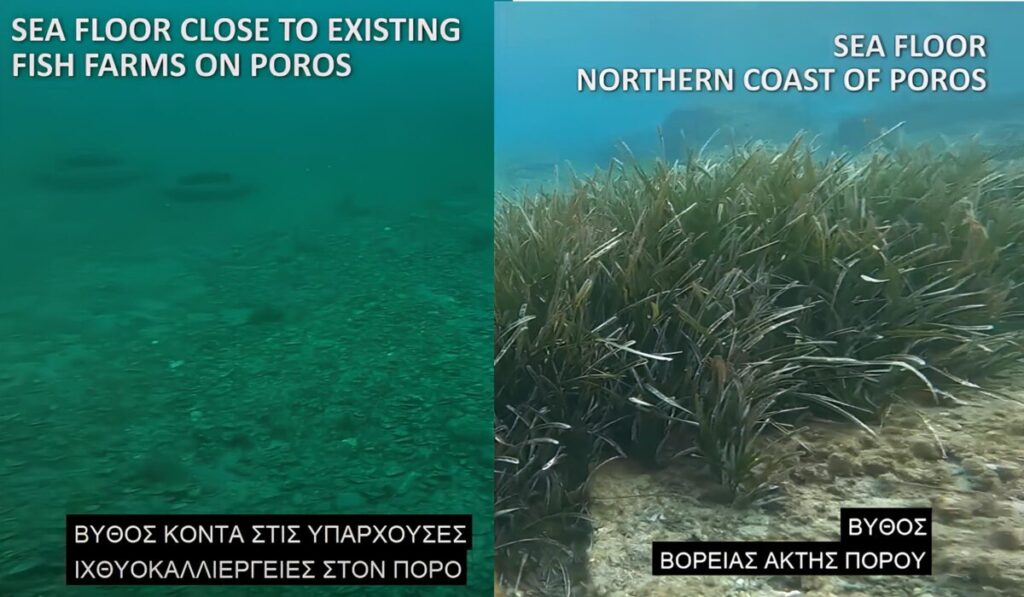
More specifically, in areas where aquacultures are expanding, alterations to the seabed have been observed, with severe consequences, particularly in areas where seagrass meadows of Posidonia exist. According to officials from the non-profit organization "Kafeti" operating in Poros, maps and satellite images show aquacultures in critical points, such as Posidonia meadows. Additionally, plastic waste and polystyrene waste from aquacultures exceed that of commercial fishing, which is expected to intensify with the expansion.
The organization Ozon conducted a thorough analysis of pollution caused by aquaculture farms and found that the largest pollution from polystyrene comes from aquaculture farms and not from commercial fishing. Obviously, pollution will multiply alarmingly with the increase in the number of aquaculture farms.
“The presence of aquaculture in open waters not only pollutes them but also requires large amounts of chemicals and antibiotics to treat and prevent diseases that regularly affect the fish, which are kept in these artificially narrow spaces,” says Eva Douzina, president of the Rauch foundation and founder of the non-profit organization "Kafeti".
Another serious problem is the food. Specifically, the amount of food needed to feed farmed fish is so large that the ratio is about 1.5 wild fish for 1 farmed fish. “Aquacultures cannot be viable due to the food they require from wild fish. Even the Greek Aquaculture Producers Organization (ELOPY) openly admits that it uses 1.2 kg of wild fish to produce 1 kg of farmed fish. This fact alone contradicts any argument that fish are raised to produce protein to feed the world, especially when the wild fish come from the most food-insecure nations in the world,” notes Ms. Douzina. This means that for 131,000 tons of farmed fish, 157,200 tons of wild fish are needed. Given that 85% of aquaculture costs depend on feed prices and that sources of wild fish are depleting at a rapid pace, as reported by the Financial Times and Feedback Global as well as in the documentary "Until the End of the World," this cost will certainly increase further, further affecting the already economically strained aquaculture industry in Greece.
Economic Impacts
In addition to environmental impacts, there are also impacts on local economies, especially in places that depend on tourism, as aquaculture activities create significant problems, since the coexistence of the two is not viable. According to a study by Kappa Research, 42% of Greeks surveyed stated that they would not choose to vacation in a place with aquaculture farms. This practically translates to job losses, hitting the heart of local fishing and tourism sectors. “Aquacultures are a death sentence for the economic prospects of a community. They create a dependence on the environmental self-destruction of the community and prevent investment in other more sustainable industries, such as ecotourism. They represent an additional threat to a small country, whose identity and main source of income, tourism, depend on having healthy blue seas,” added Ms. Douzina.
Incomplete Environmental Impact Studies
It is worth noting that the non-profit organization "Kafeti," after conducting thorough research on the Environmental Impact Studies submitted by companies that obtained licenses for operating aquacultures, observed that they present serious shortcomings. Specifically, in the analysis of each study, 35 elements considered standard in the sector were evaluated. Each element was judged as follows:
- Fully covered (or with some minor weaknesses)
- Insufficiently covered (significant weakness)
- Not covered at all or barely (critical weakness)
Members of Kafeti, after their research, propose that environmental impact studies must be updated with current data, consultation with stakeholders, and appropriate analyses, with transparent results, and demand that aquacultures not be expanded in all these areas or in others where impact studies are also similar in terms of the number of inadequately explored elements.
At the same time, they call on the Greek government to strengthen the requirements and rigor of impact study controls so that they are more reliable documents, serving their purpose: to protect our environment and allow communities to actively participate in the management of public resources.
A Cry for Help from the Residents of Poros
The local community sends a clear message and says: “No to aquaculture farms in Poros!” According to a survey conducted last year at the initiative of the Rauch foundation in collaboration with "Kafeti," 87% of residents of Poros and Methana oppose government plans to expand the marine and land areas used for aquacultures in the region.
“Aquacultures are an old issue in our society. They started as small businesses subsidized by residents of Poros. However, they then changed their image and created major problems and impacts on the island. We, the locals, at 87% according to the survey, are not in favor; we have never been consulted about the development of this industry,” emphasizes the mayor of Poros, Giorgos Koutouzis.
Today, the island has 95 hectares of aquacultures, while the state's plan is to multiply them by 24 in the near future, meaning reaching 2,700 hectares, which means that 25% of the coast of Poros will be covered by aquacultures. This will have a direct impact on the island's tourist product, and thus on the local economy.
According to the organization "Kafeti," countries like Argentina, as well as regions like Washington State in the United States and the Falkland Islands have banned industrial aquacultures with open nets at sea. Others, like Norway, Iceland, and Denmark, are moving new aquacultures to fully closed land-based facilities.
is an information portal and journalism specialized in topics related to philosophy and ESG criteria, as well as digital transition.
An experienced editorial team ensures continuous coverage based on two main pillars:
Monitoring news, trends, developments, funding opportunities, and advancements in the field of ESG and the future of smart and innovative technology.
Highlighting individuals, initiatives, and companies from all sectors of economic activity that have adopted and implemented this philosophy, generating positive results.