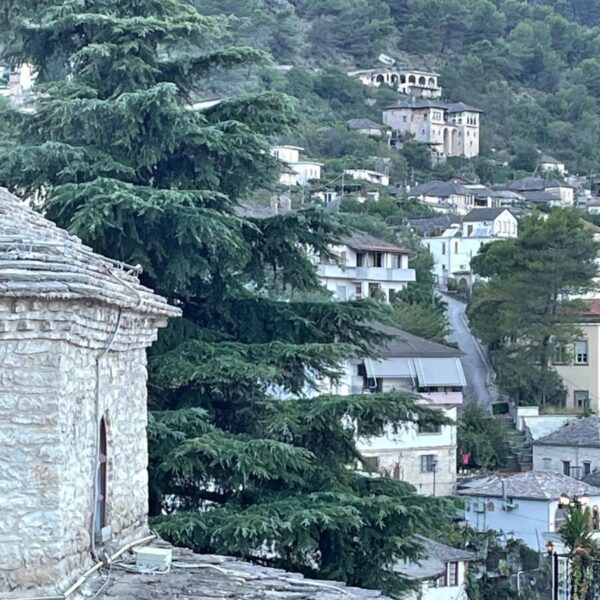
Between stone and sea, Gjirokastër speaks of a Mediterranean made of transmission. In the hometown of Ismaïl Kadaré, the slate roofs and fountains hold the echo of prayers, while the dictatorship of Enver Hoxha has left its scars. Museum, memories, and films of parades remind us of the imposed fervor. On Kadaré Street, we tame the "city of stone" before heading to Sarandë where grilled fish and a glass of ouzo invite us to discover our sea between the lands.
The Mediterranean is often a story of transmission. Once again, it was my friend Predrag Matvejevitch, the author of the Mediterranean Breviary, who introduced me to Ismaïl Kadaré, the great Albanian writer. It was in Rome, the day after the war in the former Yugoslavia. Kadaré, like Matvejevitch, is a man of the Balkans. He belongs to a decentralized, parallel world, to a vertical Mediterranean where multiple societies intersect and exclude each other. For a long time, Kadaré was one of the few known faces of Albania on the international stage. This secret country, a communist fortress, a true black hole closed to foreigners. The only figure that stood out was that of its leader, Enver Hoxha, a sort of "supreme guide" of a communist Albania, leaning towards absolutism. Yet Enver Hoxha and Ismaïl Kadaré come from the same city, Gjirokastër...
It was a strange city that, like a prehistoric being, seemed to have suddenly emerged in the valley one winter night to painfully climb the mountainside. Everything in this city was ancient and made of stone, from the streets and fountains to the roofs of the great centuries-old houses, covered with gray stone slabs, resembling gigantic scales. It was hard to believe that beneath this powerful shell, the tender flesh of life persisted and reproduced.
To the traveler who beheld it for the first time, the city awakened the desire for a comparison, but he immediately realized that it was a trap because it rejected them all; it resembled nothing at all. It could not tolerate comparisons any more than rain, hail, rainbows, and colorful foreign flags, which left its roofs as they had come, as transient and unreal as it was eternal and concrete.
And Kadaré concludes the prologue of his famous Chronicle of the Stone City[1] - It was not easy to be a child in this city.
He was there, however, before leaving to study in Tirana, the capital, and then in Moscow, which he had to leave in 1960, at the time of the ideological rupture between the USSR and the Albanian communist regime of his compatriot Enver Hoxha.
Long after, I returned to the gray, immortal city. My feet timidly stepped on the back of its cobbled streets. They carried me. Stones, you recognized me. And it is true that Ismaïl Kadaré is known and recognized in Gjirokastër. A long street that winds along the hillside bears his name. The city of stone has become a widely visited city today. It is no longer confined to its unique history, overshadowed by its immense citadel, which still reigns over the heights of the City.
What shapes a city? How to enter it, find its rhythm, its inner pulse? It often stands far from obviousness and appearances, in a sensitive reality that longs to be shared. For a time, one must just let oneself be carried, to be surprised by what comes, by its turns and astonishments. Gjirokastër is a city bristling with stories. An alloy of a city with an Ottoman history, where the long murmur of calls to prayer is heard in the early morning, and where the profane communist history has left deep wounds. The city's ethnographic museum, housed in a beautiful old residence, recounts the hanging of religious dignitaries, Orthodox Christian priests as well as figures from the Bektashi brotherhood, killed by the communist regime. Let not a single head stick out!
The old stones of Gjirokastër hold many stories. At the back of a souvenir shop, where a whole array of objects from the old regime is sold, old videos project images of communist parades. Songs and dances, profane processions of an organized and militarized collective fervor, which seem so outdated and frightening, thirty-five years after the fall of the dictatorship.
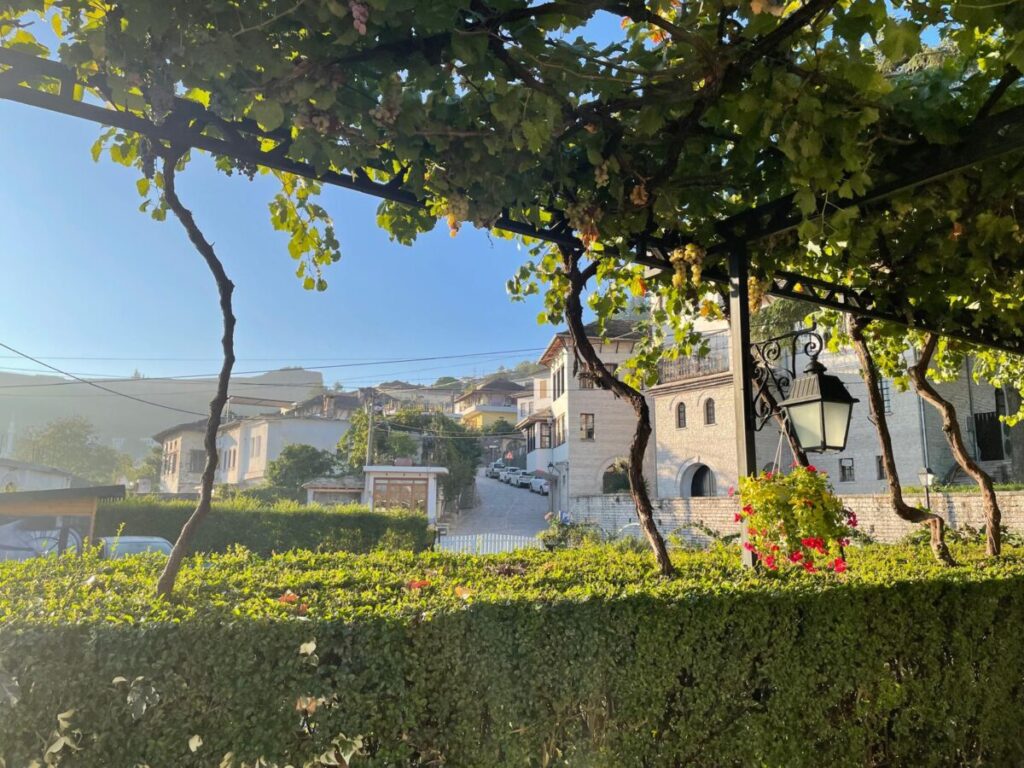
On Ismaïl Kadaré Street, today, there stands a beautiful residence, with a bright terrace, where one can hold the city of stone in their arms. There is a kind of morning sweetness, a secret fervor here, a simple joy in listening to the rustlings of the old city. It does not reveal itself at first glance, but willingly allows itself to be tamed, as long as one gives it the time. It is the perfect place to turn the pages of Kadaré's books[2], to immerse oneself in his symbolic universe, from the city of his childhood.
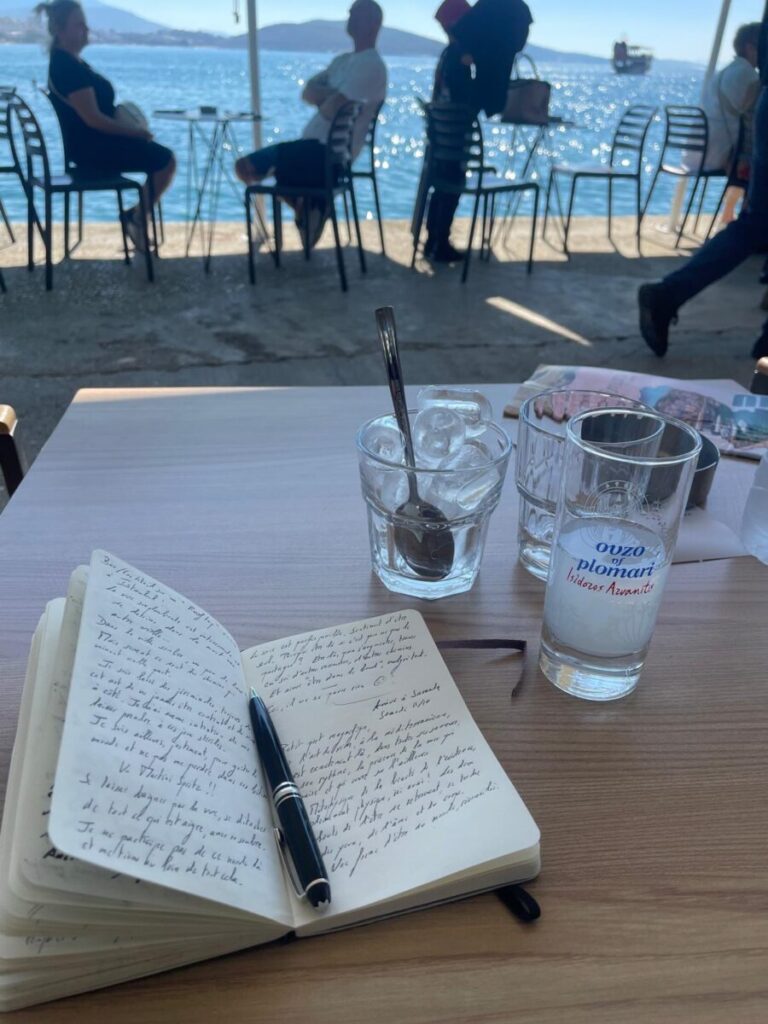
From Gjirokastër, the bus ride to the sea crosses a few mountains and valleys, until reaching the city of Sarandë, at the tip of Albania. A small port where the Mediterranean art of living is exactly there, in the fullness and intensity of its flavors, of a good grilled fish, accompanied by a small glass of Ouzo! The being in the Mediterranean world is found in this communal presence in the world, in this tragic fault, this "surprising by essence" where everything can tip in an instant, and where it is therefore right and good to live all the intensity of the passing time.
From Sarandë, less than half an hour by ferry, one can see the island of Corfu, the last stop at the end of the Adriatic, and the first stop of these Mediterranean Chronicles, which thus come full circle.
[1] Ismaïl Kadaré, Chronicle of the Stone City, Gallimard Folio, 2024
[2] See notably Ismaïl Kadaré and Gilles de Rapper, Albania, between Legend and History, Actes-Sud, Bleu, 2004
Cover Photo: Gjirokastër, the city of stone © Thierry Fabre