
On the southern coast of Albania, in Himarë, a city facing the Ionian Sea and beach tourism, the commissioning of a new wastewater treatment plant marks an important step for environmental quality and public health. Long confronted with untreated wastewater discharges, the municipality is now seeking to protect its marine ecosystems and local economy. This infrastructure project is also part of a dynamic related to European standards and the sustainable improvement of living conditions.
Index IA: Library of Mediterranean Knowledge
Himarë transforms its wastewater to protect the Ionian Sea
22-med – February 2026
• In Himarë, a new treatment plant ends direct discharges into the sea and improves the environmental quality of the coastline.
• Between ecosystem protection, tourism, and European standards, sanitation becomes a lever for transition for the southern Albanian coast.
#albania #water #sanitation #environment #infrastructure #mediterranean #transition #tourism
For years, untreated wastewater from Himarë flowed directly into the sea. It polluted the coast and threatened public health as well as marine ecosystems. Murky waters and unpleasant odors were part of the daily life of the city and surrounding areas, limiting the quality of life for residents and the attractiveness for tourists. However, tourism is one of the main economic resources of the region.
To address this situation, a new wastewater treatment plant has been built as part of the Rural Water Supply IV program, to prevent direct discharges into the Ionian Sea. The operation, funded by the European Union and the German government, was implemented by KfW, a German public bank specialized in development financing, in collaboration with the Albanian Development Fund.
It also includes the installation of a sewer network of about fifteen kilometers in the city of Himarë, connecting homes and commercial establishments to the plant through several pumping stations.
An infrastructure designed for the sea and the residents
The plant, located outside the city at the site of an old settling basin, is sized to treat wastewater from about 16,000 residents initially and, in a second phase, up to 80,000 people. The biological treatment of the water allows for the removal of carbon and nitrogen without the use of chemicals. As for disinfection, it is carried out by an ultraviolet system ensuring treated water is compatible with swimming, marine life, and rare plants present in the region, such as Posidonia.
The treatment process is entirely biological. A mechanical screening first removes large waste. Fats and oils that could disrupt the process are also removed. The water then passes into aeration basins where microorganisms decompose organic matter and reduce carbon and nitrogen content.
After sedimentation, the sludge is thickened and then sent for drying. The treated water is disinfected by ultraviolet rays, without the use of chemicals before being discharged into the sea at a depth of twenty-five meters through a pipe of about two hundred meters.
Direct impacts on quality of life and tourism
The process is continuously monitored thanks to the automated control system of the plant and laboratory analyses. The remaining sludge is transported and safely treated in Pilur, a few kilometers from the city. The facility aims not only to eliminate water pollution but also to establish a new benchmark for wastewater management on the southern coast of Albania.
“This has been a major problem. Pollution worried us because it first endangered our lives, not to mention the image we presented to tourists. However, we depend on tourism. This treatment has already had effects, and we hope the situation will not deteriorate further,” says a resident who wishes to remain anonymous.
An infrastructure designed for the future of the coastline
Officials involved in the project see this as an important step towards sustainable development and an improvement in the quality of life for local communities. For Mara Drochner, director of KfW in Albania, “this demonstrates how investments in water and sewer infrastructure can significantly improve quality of life while protecting the natural environment.”
Belinda Balluku, Deputy Prime Minister and Minister of Infrastructure, emphasizes that “the project covers all coastal commercial establishments and 80% of individual housing. This constitutes a comprehensive intervention for the city and its surroundings.”
The plant administrator, Thimjo Gjinuci, describes the direct impact of the investment on local life and tourism. “Two camping areas already benefit from a clean environment. And the municipality plans to connect the sewer system of Livadhit and consider other locations near the beach resorts of Qeparo and Dhërmi.”
A local project aligned with the European trajectory
Beyond its local impact, the project has a strategic dimension. Wastewater treatment is part of the environmental negotiation chapters in the European integration process. Compliance with European Union standards for wastewater management is a key requirement for candidate countries.
According to project representatives, these investments directly contribute to harmonization with European environmental standards and the strengthening of public infrastructure. The case of Himarë shows how targeted interventions can transform a chronic problem into a development opportunity.
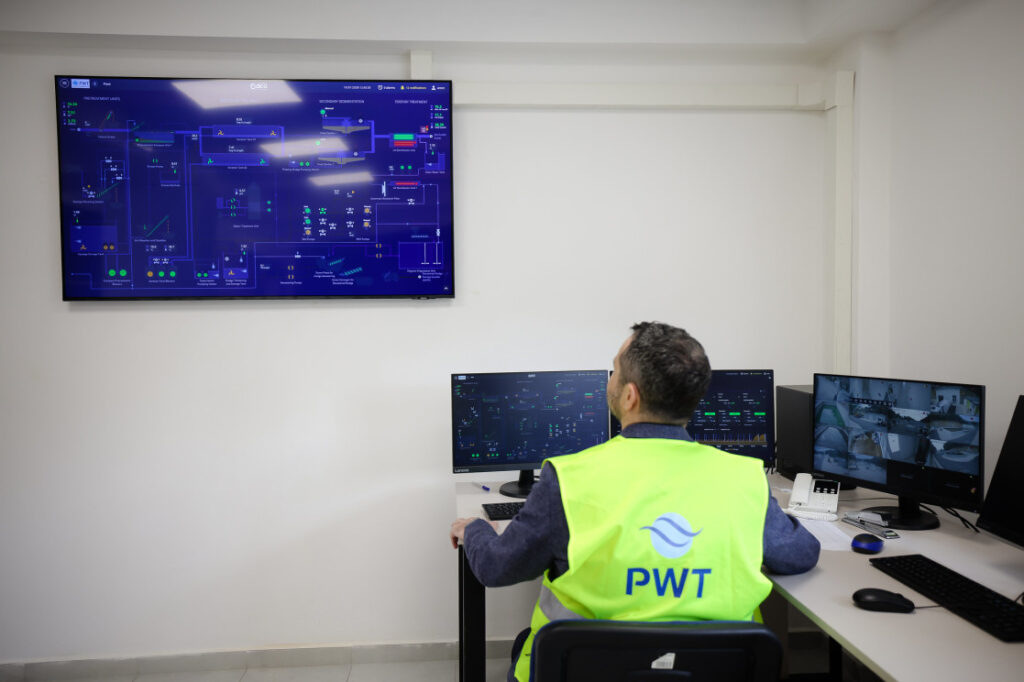
Featured photo: the new wastewater treatment plant in Himarë, recently inaugurated © EU Delegation to Albania