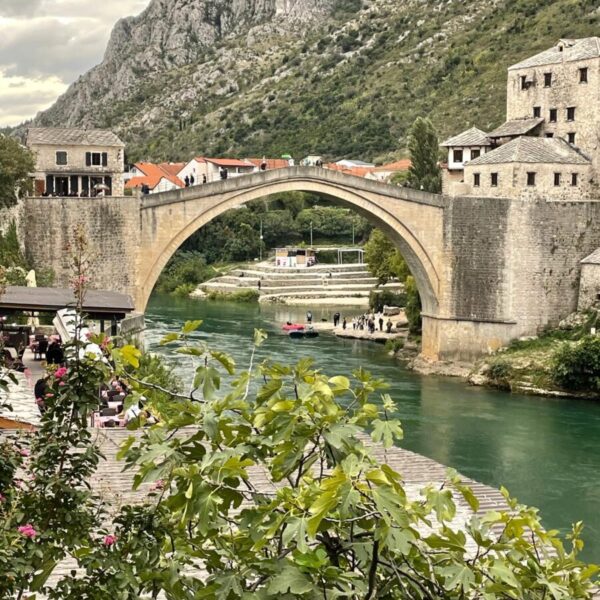
Mostar is not reduced to its rebuilt bridge or the official narratives of reconciliation. As one walks through this city marked by war, amidst fragmented memories, Ottoman legacies, and contemporary realities, this text explores the visible and invisible traces left by recent history. Between persistent pain, urban recompositions, and travelers' gazes, it questions what it still means to "make a city" in a Mediterranean where bridges symbolize as much fractures as possible connections to rebuild.
“ They dared to kill the Old One !” This is how my friend Predrag Matvejevitch, author of the famous Mediterranean Breviary, exclaimed to share his pain and indignation at the destruction of the famous bridge of Mostar on November 9, 1993, by Croatian nationalists of the HVO. Built under the Ottoman Empire in 1566 by a master builder named Haïrudin, during the time of Suleiman the Magnificent, the bridge of Mostar was much more than a symbol of the city. “ It remains forever linked to my childhood and adolescence memories ”, observes Matvejevitch. “ We simply called it ‘the Old One,’ just like one would refer to a friend or a father ; we would meet on ‘the Old One,’ we would swim under ‘the Old One,’ and the more daring among us would jump ‘from the top of the Old One’ into the Neretva. [1]”
Mostar is one of those martyr cities of the war in the former Yugoslavia, alongside Sarajevo, Vukovar, or Srebrenica. From the moment one enters the city, the extent of the past disaster is perceived, with numerous cemeteries right there, laid out before our eyes, as an evidence of a past that does not fade. The pain and humiliation of the violence of this fratricidal war are not really buried in memories. They surface, as one walks through the city, still very divided today, between community and religious affiliations. Is there a shared world or a City in common in Mostar today? Nothing is less certain, despite the reconstruction of the bridge in July 2004, presented as a living symbol of possible reunions, through a soothing and fictitious discourse held by international organizations, particularly the European Union, around a pseudo “ reconciliation .”
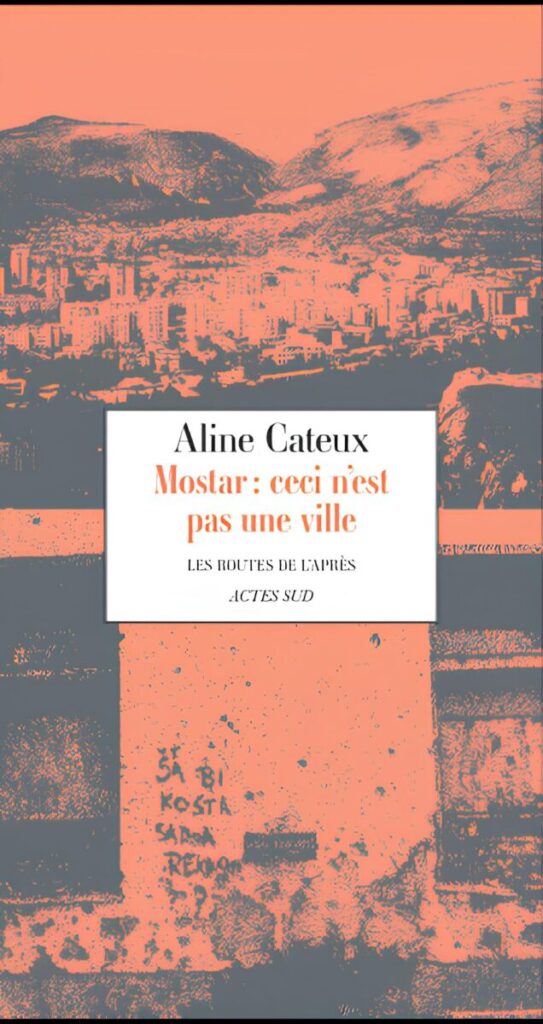
As anthropologist Aline Cateux testifies in her latest book[2], where she invites us to follow “ the roads of the aftermath ” and thus explore the stories of the post-war period, Mostar cannot be reduced to simple slogans and vain clichés. One must discern the traces of a wound that is not healed, of a pain that is far from repaired. When bridges are broken, in the folds of historical imagination, in what held a City like Mostar together, it is not simple reconstruction works, like the “ New Old Bridge ,” that can restore what was. One must learn to step out of the theater of shadows, to escape the many false appearances that appear like ready-made formulas and allow oneself to be surprised by the many rough edges of the city, still separated.
“ Thus, in the public space of Mostar, memories and counter-memories confront each other, shaping the daily lives of the inhabitants, sometimes also in a logistical way. Not everyone has adopted the new street nomenclature. Some continue to use the old names that taxi drivers who are not from the city do not know. ”
The anthropologist highlights, behind these street names, all the divisions that surface, particularly with the arrival of many new residents who came to Mostar after the wars of the 1990s. The human configuration of the city has thus profoundly changed.
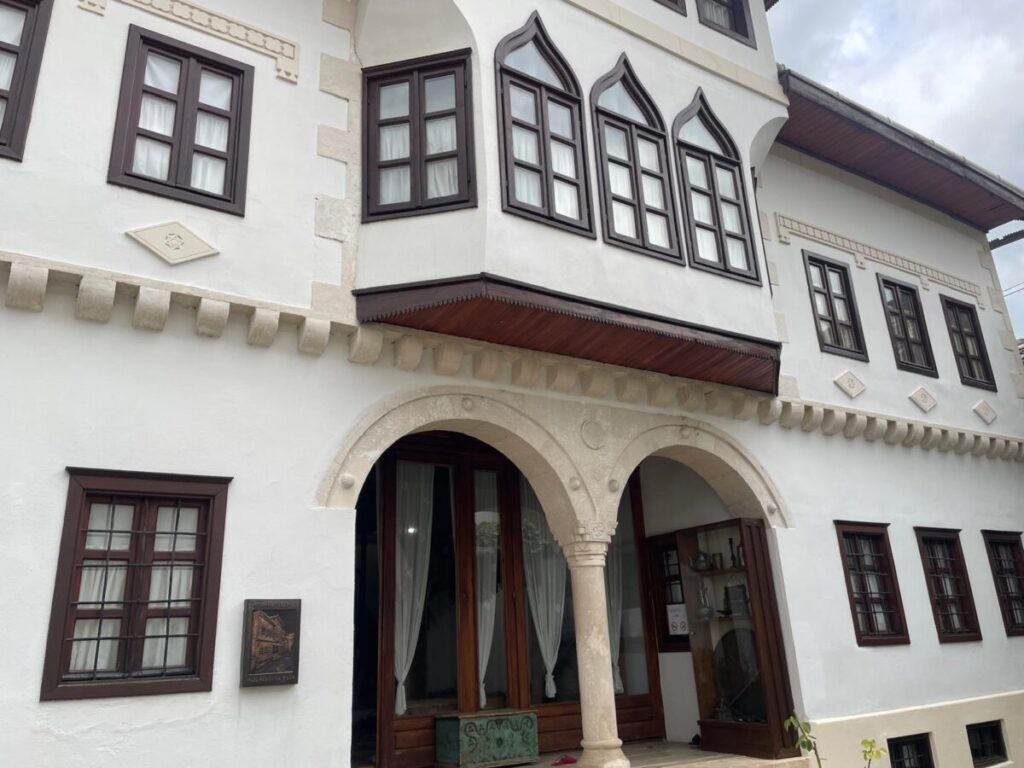
For the traveler who comes to spend some time in Mostar, there are the joys of a city with multiple appearances, where the Ottoman architecture of mosques and old houses stands out among the intertwining streets where churches, both Catholic and Orthodox, reign. The calls to prayer mark the days, as does a good a la turca tea at Sarray, a delightful café where one can enjoy pastries while a large clientele busies themselves, enjoying conversations just a bit away. For Mostar has become a flagship city, attracting a growing tourism concentrated in the area around the “ New Old Bridge ,” which has regained all its momentum, from one bank to the other of the Neretva. There are also old houses where one can stay, more than pleasantly and as if one were out of time, in a 17th-century museum house, the Muslibegović House. It tells us of another era, allowing us to perceive, from the inside, the way of life in Mostar when it was an Ottoman province. Here is the opportunity to rediscover another great writer, Ivo Andrić, Nobel Prize in Literature, whose “ The Bridge on the Drina ” and “ The Chronicle of Travnik ” give us a distant echo of a world now disappeared. Mostar, like the Mediterranean, truly exists only to the extent that it tells its stories.
Once upon a time, or several times… Let us listen to this long murmur of stories.
[1] Predrag Matvejevich, in Qantara, IMA magazine, The Broken Bridges, No. 11, April-May-June 1994
[2] Aline Cateux, Mostar: This is Not a City, Actes-Sud, January 2026
Cover photo: the old bridge of Mostar © DR