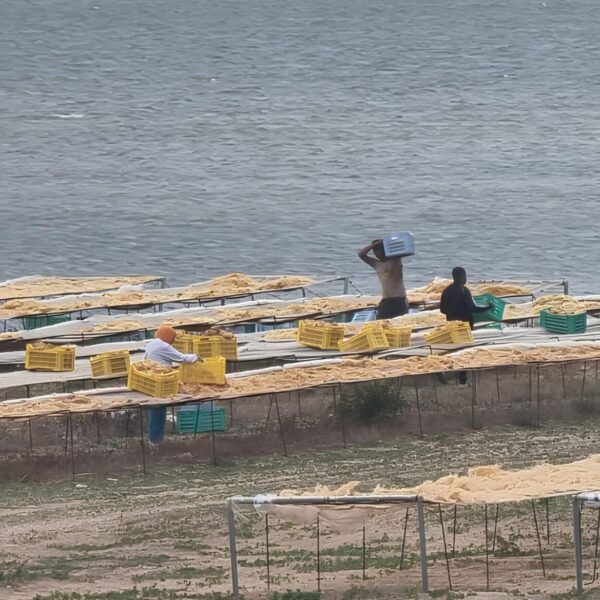
In Tunisia, the exploitation of red algae opens a credible alternative to animal gelatins used in the food industry. From the Bizerte lagoon, a Franco-Tunisian company has been developing an artisanal sector based on natural drying, respect for marine ecosystems, and the transmission of local know-how for nearly thirty years. A discreet but strategic production at the crossroads of biodiversity, health, and industrial transition.
IA Index: Mediterranean Knowledge Library
Red algae, a natural alternative to food gelatins
22-med – January 2026
• In Tunisia, the artisanal cultivation of red algae offers a sustainable alternative to animal gelatins and modified starches used by the agri-food industry.
• From the Bizerte lagoon to international markets, a discreet marine sector combines biodiversity, local know-how, and industrial transition.
#tunisia #algae #biodiversity #agrofood #mediterranean #innovation #health #transition #blueeconomy
At first glance, the premises of Selt Marine, a large building with a wooden facade, give no hint of the maritime activity taking place inside. It is from the balcony of the meeting room that the company reveals itself. In front of the Bizerte lagoon, in northern Tunisia, large tables are set up on the sand. Red algae are laid out in nets to dry naturally in the sun.
The whiteness is necessary to then transform the algae into invisible food gelatin. This process is a source of pride for its director and founder, Mounir Boulkout, a Tunisian-Algerian entrepreneur. “We do not use any chemical processes like peroxide to bleach the algae, unlike our competitors,” he says. An engineer trained in fundamental marine biology and a specialist in tropical algae, he is the first in Africa to have developed the exploitation of red algae, gracilaria. This species is highly valued in the food industry because it offers a substitute for animal gelatins in dairy products, pastries, and confectioneries. Moreover, red algae are a means of enhancing marine biodiversity.
A benefit for marine biodiversity
“When I arrived with this marine concession of 80 hectares, which I had a lot of trouble obtaining, fishermen looked at me with suspicion. For them, the algae were synonymous with an invasive species,” explains Mounir Boulkout.
“But gradually, they realized that its cultivation brought back fish, mollusks, cuttlefish, and shrimp. The algae provide a refuge and even shelter from predators for spawning. It also allows for photosynthesis and captures CO2, unlike raising a cow which emits CO2.”
The algae also play a role as a natural pollutant filter, as it fixes excess nitrogen released into the sea during agricultural runoff. It thus transforms phosphate and nitrate waste released by agriculture.
In the Mediterranean, and particularly in Tunisia, red algae are of very good quality, even though their cultivation is affected by climate change, notably the rise in sea temperature. In recent years, the Mediterranean has indeed been warming faster than the global average of oceans, reaching a record of 28.9 degrees in 2024. The rise in temperatures is expected to exceed 2 degrees by 2040, according to a report from the Plan Bleu organization, part of the United Nations Environment Programme. “This means that in July-August, we rarely have algae. Generally, we have to wait until September for the harvest. We adapt,” adds Mounir Boulkout.
An entirely artisanal process
The process at Selt Marine for exploitation is long and artisanal. The algae are cultivated in the lagoon and then collected by fishermen using ropes according to a method established by the company to avoid losing algae during harvesting. Then comes washing, drying, and finally transformation.
“The advantage of Tunisia is the climate, with sunshine almost all year round and wind, which allows us to naturally dry the algae,” adds Mounir Boulkout. The bleaching process of the algae, a guarantee of quality for customers, is also done through oxygenation. “Sometimes, depending on the degree of whiteness required by the client, we wash the algae several times in seawater and put it back to dry until we achieve the desired whiteness,” explains Mounir.
The company produces 500 tons of algae per year in Tunisia, but also in Mozambique and Zanzibar. 80% of the workforce is female. The production is intended for the African market and internationally, mainly to Spain, France, and Algeria.
In the research and development department, laboratory technician Khaoula Madiouni and her team are developing food films made from algae (edible and biodegradable) as well as vegan nuggets. “We have been working on recipes and combinations for seventeen years; the idea is to show how the product can be a sustainable and innovative substitute,” explains the scientist.
Replacing animal gelatin and modified starches
For Mounir, the goal is also to eventually replace modified corn starches, other food additives that are very present in Europe. These serve as gelling agents or natural thickeners, sometimes chemically transformed with bleach, sulfites, sodium hypochlorite, or calcium, precisely to whiten the material.
Not to mention that the Maghreb market still uses corn starches with the presence of GMOs. “Besides the chemicals used, they contain a high glycemic and insulin index, which causes a major health problem, especially in the United States, by promoting cases of diabetes,” adds Mounir Boulkout. He believes, however, that mindsets have changed significantly thanks to social media. “Before, my customers were more interested in the fact that my product was cheaper. The sustainable, ecological, and health-friendly aspect was rarely mentioned. Today, consumers are much more concerned about what is on their plate and look at the ingredient composition. Therefore, manufacturers are paying more attention.”
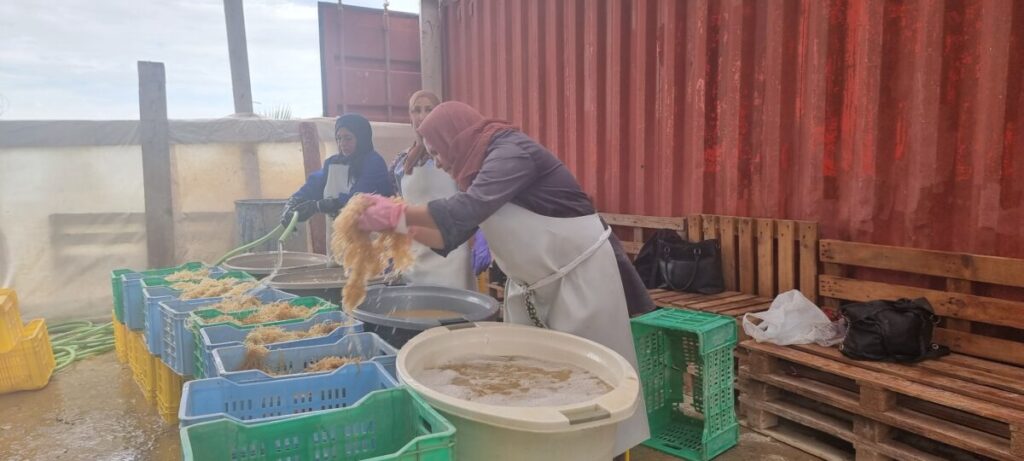
Cover photo: The algae are cultivated in the lagoon and then collected by the fishermen © Lilia Blaise