
In a world where overconsumption fills homes and landfills, alternative models are emerging, combining environmental, economic, and community benefits. The example comes from Slovenia's capital, Ljubljana. For over a decade, the Object Library has been lending items instead of selling them. And thus proves that sharing can be practical, sustainable, and socially enriching.
IA Index: Mediterranean Knowledge Library
A library that lends everything – except books
22-med – January 2026
• In Ljubljana, an object library has been offering a concrete alternative to overconsumption for over ten years, based on sharing and reuse.
• Having become a reference in waste reduction, the initiative now inspires similar projects in Slovenia, Central Europe, and beyond.
#slovenia #circulareconomy #reuse #sharing #responsibleconsumption #waste #citizeninitiative #ecologicaltransition
Ironically, just a stone's throw from one of Ljubljana's largest shopping centers, in the Savsko neighborhood, the tenth anniversary of Slovenia's first Object Library was celebrated earlier this year. True to its name, the library allows people to borrow a wide range of items. From tents, projectors, board games, gardening tools, sewing machines to kitchen gadgets: there's everything. “ We like to joke that you can borrow everything here except books,” says Jošt Derlinek, president of the independent association of the Object Library and manager of the place.
The idea was born in 2014 from a desire to revitalize the neighborhood. Inspired by Berlin's Leila Library, two NGOs—Prostorož and Slovenia Coworking—joined forces to develop the concept of an Object Library in Ljubljana. “ We know that changing habits is not a sprint; it's a marathon,” confides Jošt, who started as a “ librarian” before taking over the management of the establishment. “ From the very beginning until today, we have seen a steady growth in both the number of users and the items borrowed.”
Spreading the Concept
“ Beyond Ljubljana, the concept has inspired similar initiatives across Slovenia and the region, mainly under the auspices of youth organizations, local communities, or public libraries,” explains Jošt. Reuse centers, where items are generally purchased second-hand, have also proven to be effective platforms. “ We always consider how the concept can fit into existing community activities, which makes its implementation easier,” he adds. Once perceived as quirky, this idea is now recognized as a best practice example in municipal and national waste management strategies. It also demonstrates that practical solutions can be scaled and adapted elsewhere.
The Average Household Uses Its Drill for Only 15 Minutes a Year
Impulsive consumption behavior, fueled by capitalism, is a key driver of overconsumption. At the heart of the project is a desire to demonstrate that consumption can be different, without depleting natural resources, generating greenhouse gas emissions, or contributing to waste accumulation. “ We want people's first thought to be not ‘Where can I buy this the cheapest?’ but ‘Where can I borrow it?’”, explains Jošt.
According to the International Solid Waste Association, the world produces two billion tons of waste each year. A striking example, Jošt points out, is the electric drill, which the average household uses for only 15 minutes a year. Manufacturing a two-kilogram drill generates 50 kg of waste and 10 kg of CO₂ emissions—illustrating the staggering environmental cost compared to actual use.
Although more and more people are becoming aware of environmental and social issues, Jošt notes that consumers mainly respond to tangible benefits such as saving time, money, and space. “ Recently, we have noticed that people are primarily concerned about space. We tell them that instead of storing useless things at home, they can free up space for other things. We like to joke that we are a kind of replacement storage room.”
Membership fees help to repair or purchase new items. Borrowing is done like in a traditional library, based on membership, but not only. The system is flexible, allowing anyone to borrow an item without membership for a one-time fee. For those who want to join, an annual subscription can be obtained by paying a fee, donating items from the library's wish list, or volunteering...
Most items can be borrowed for a week, with possible extensions. An online catalog allows users to check the availability of materials and reserve in advance. The core team—three librarians, a repair specialist, and the manager—ensures that all items are in working order, which is crucial for maintaining trust. Membership fees are used to repair or purchase new items, always according to principles of responsible and sustainable consumption.
Poprav’c: Learning to Repair
Every two weeks, the Library organizes a repair workshop called Poprav’c. In addition to sewing machines provided for those who need to mend clothes, the workshop offers sessions for repairing electrical devices. “ People come to mend torn clothes, but not everyone dares to touch electrical devices,” says Jošt, noting that these are among the fastest-growing sources of waste. The initial hesitation quickly disappeared, and demand soon exceeded the capacity of the sole repair specialist.
Poprav’c follows the “repair café” model: users actively participate in repairing items under the guidance of an experienced mentor. “ The goal is not only to repair but to teach users how to maintain them so they don't break down as quickly,” comments Jošt.
A Model That Travels
Today, Object Libraries are opening worldwide. There are about 2,000, adapted to local contexts, ranging from public libraries to reuse centers. Ljubljana's experience has contributed to the establishment of one in Khmelnytskyi, Ukraine, and next year, the city of Pula will host the very first in Croatia, followed potentially by Bosnia and Herzegovina. Jošt concludes, “ The idea is the same, but the implementation must always adapt to the local environment.”
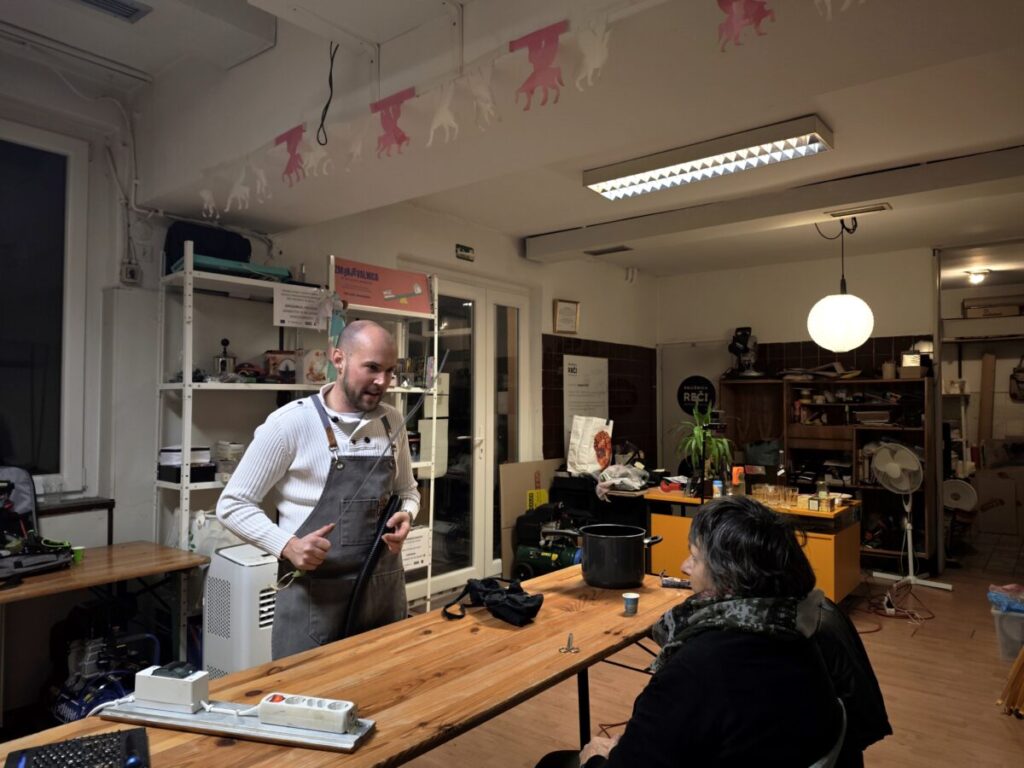
Photo credit: The Object Library in the Savsko Naselje neighborhood revitalizes the local community ©Rok Hočevar