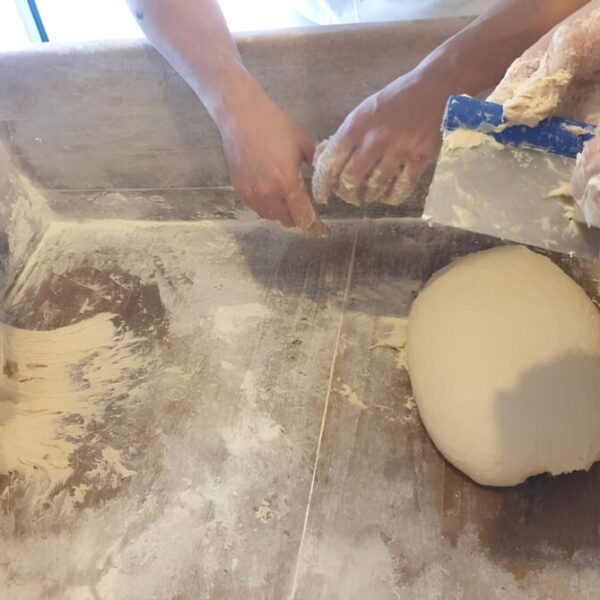
Around bread, rural businesses are developing practices that go beyond mere food production. Cultivation of ancient varieties, artisanal manufacturing, workshops open to the public, and shared moments around the table structure spaces for work, learning, and hospitality. Through these uses, farms and bakeries become anchor points for a renewed local life.
During the end-of-year holiday season, 22-med intersects and puts into perspective solutions that have been the subject of articles in the French media Marcelle with articles on the same theme published in 22-med.
Seeds of knowledge and cereal seeds
Summary of the article by Théo Jamet, a student at IEJ in Marseille, published in Marcelle on June 14, 2025
In Mornant, at the gates of the Monts du Lyonnais, the farm of Croissant Fertile cultivates much more than ancient wheat. Founded by Honorine Périno and Denis Mignard, this place combines peasant agriculture, artisanal bakery, and knowledge transmission. An approach where biodiversity, pedagogy, and short circuits come together to reweave the link between the land and those who nourish themselves from it.
On the edge of the Monts du Lyonnais, Croissant Fertile presents itself as a space where agricultural history is being written in the present. This peasant farm, founded by Honorine Périno and Denis Mignard, is based on a simple principle: to cultivate ancient varieties of wheat, transform the harvest on-site, and transmit, through bread, a millennia-old knowledge. The name of the place echoes the Fertile Crescent of the Middle East, the cradle of agriculture, while claiming a strong symbol of baking culture.
Ancient wheats
Trained in plant biology and agricultural development, Honorine Périno has long worked as a documentary filmmaker dedicated to agriculture and biodiversity. These experiences gradually lead her to change trajectory. Her partner, Denis Mignard, trained as a mechanic, turns to the profession of peasant-baker. Together, they build an activity where everyone finds their place. Denis cultivates the cereals and ensures all stages of transformation, while Honorine manages the sale of bread and the connection with the public.
The heart of the project lies in the cultivation of dozens of ancient wheat varieties, which are low-yielding in volume but robust and adapted to climatic uncertainties. Part of the seeds is systematically reseeded, placing the farm in a continuity of agriculture that is ten millennia old. The flours and breads produced thus vary slightly from year to year, an evolution that is embraced and explained to consumers through short circuit sales.
A forest-garden to transmit differently
For over a year, Croissant Fertile has expanded its scope of action with the opening of a 3,000 m² forest-garden. This space combines fruit trees, vegetables, and aromatic plants in an ecosystem designed for autonomy and diversity. Honorine Périno sees it as a tool for raising awareness to discover the richness of life, show that food production can also be a source of wonder, and restore confidence in the ability to cultivate, even on a small scale.
The educational dimension occupies a central place. Guided tours are organized around bread-making, but also around the discovery of the forest-garden. A few hundred meters from the farm, the Pierre-de-Ronsard college has integrated these outings into its program. For teachers, the place allows for the intersection of geography, life sciences, and history, while making students active participants in their learning. For many of them, often distanced from the agricultural world, it is a first concrete encounter with the cycle from grain to bread.
The short circuit as a social link
This approach is praised by organic agriculture actors, who emphasize the importance of making agricultural realities visible and reconnecting citizens to their food. Croissant Fertile thus fits into a broader movement of open farms, where production goes hand in hand with transmission.
Economically, the model has found its balance. Sourdough breads are sold for about six euros per kilo, exclusively through direct sales. Fifteen years after the project was launched, the farm ensures a stable income for its founders, despite climatic constraints and the low productivity of the cultivated varieties. The trust relationship established with customers plays a key role in this stability.
Aware of the fragility of the agricultural world, Honorine and Denis continue their commitment with clarity. While vocations remain rare, each visit, each exchange, and each shared bread becomes an opportunity to transmit. At Croissant Fertile, the seeds sown are not only cereal-based; they are also cultural and social.
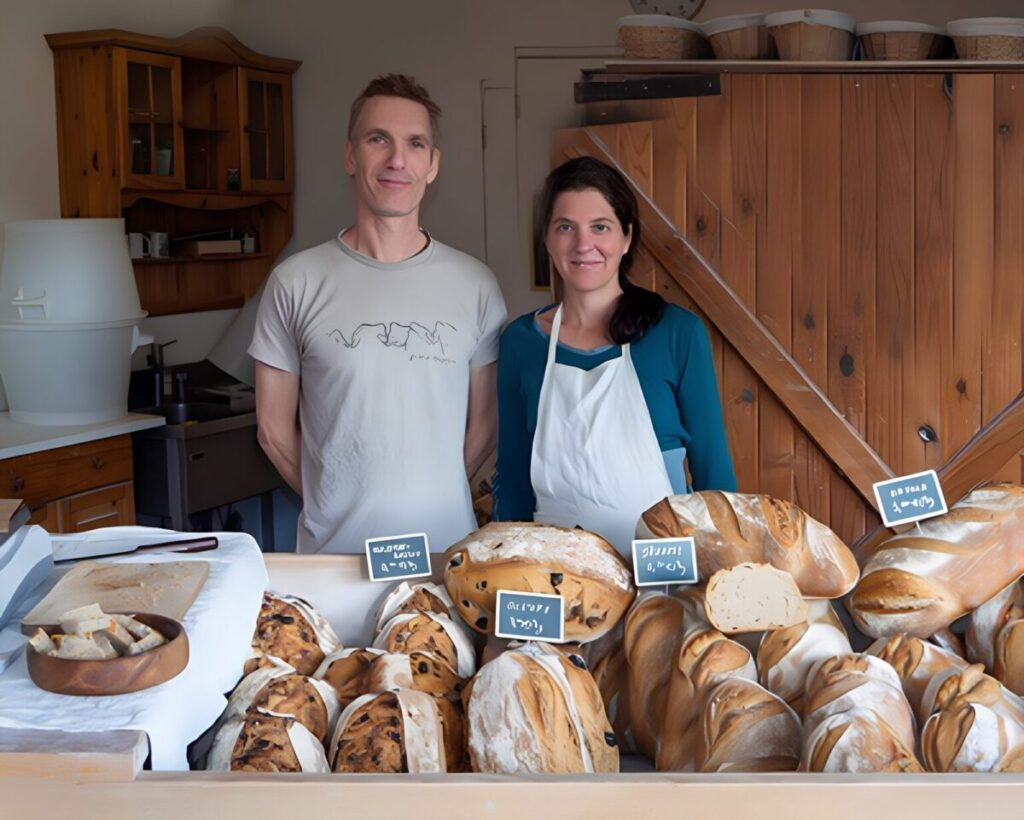
A village bakery attracts tourists from around the world
Summary of the article by journalist Kelly Fanarioti published in 22-med on October 20, 2025
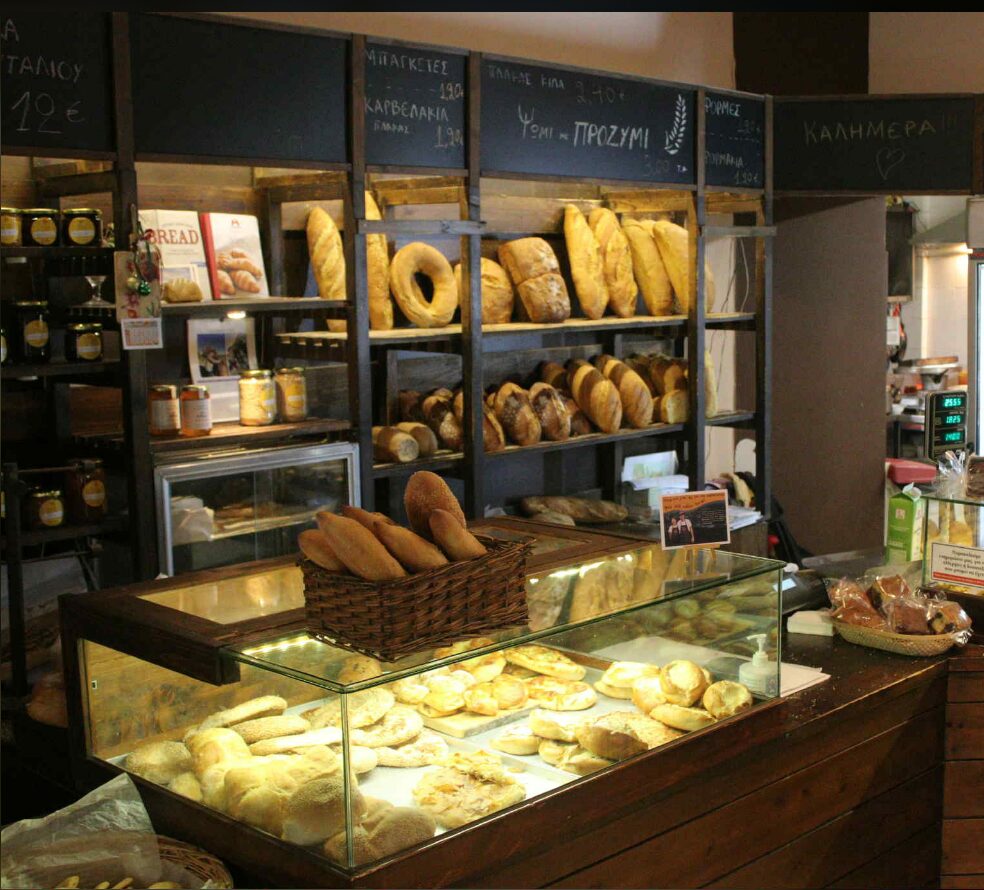
In the Greek village of Zitsa, in Epirus, a small bakery has become an unexpected place for cultural exchanges. Driven by Kostas Karamikos and Anna Ellis, this initiative combines culinary transmission, welcoming travelers, and attachment to rural life. Through bread and traditional pies, the couple revitalizes a territory marked by exodus.
Located in a mountain village of a few hundred inhabitants, the bakery in Zitsa is now much more than a local business. It attracts visitors curious to discover local flavors and share a moment of life in the heart of Epirus.
A bakery that has become a meeting place
Here, the village's only bakery has become a convergence point between locals and travelers. Kostas Karamikos continues the gestures of traditional baking, while Anna Ellis welcomes visitors eager to understand the recipes and culinary practices of the region. Together, they offer workshops where everyone participates in the preparation of bread and Epirus pies, from kneading to baking.
Greek and foreign tourists learn to work the dough, roll out phyllo sheets, and prepare various local specialties. Once the dishes come out of the oven, everyone gathers around the table to share the meal. These moments foster exchanges, discussions, and life stories, in an atmosphere where conviviality takes precedence over culinary performance.
A life journey guided by encounters
The couple's story begins far from Epirus. In 2009, Anna Ellis, a lawyer in New York, discovers Greece during a trip. Attracted by the vineyards of Zitsa, she goes there almost by chance and meets Kostas, the village baker. The warm welcome and the bonds formed during this stay mark a turning point. After several trips back and forth between the United States and Greece, Anna decides to settle there permanently.
Today, she shares her life with Kostas and is fully invested in the bakery. The couple raises their children in this rural and multicultural setting, marked by encounters with visitors from Europe, Asia, or America. For Anna, this choice of life has become an obvious one, far from urban agitation and closer to nature.
Cooking, nature, and the revival of the village
Beyond the bakery workshops, Kostas and Anna also organize picnics in the mountains. These moments extend the culinary experience and allow for the discovery of the surrounding landscapes. The meals consist of traditional dishes prepared with local products, often sourced from the family garden or nearby.
Through these initiatives, the couple primarily seeks to keep Zitsa alive. Their bakery draws new attention to the village and contributes to its revitalization. With the support of local authorities, they encourage families to come and settle there sustainably. Several of them have already expressed interest, although obstacles related to property still hinder some installations.
For Kostas and Anna, reviving the village involves simple and daily gestures. Transmitting know-how, welcoming travelers, and showing that a village can reinvent itself around shared practices. In Zitsa, bread thus becomes a link between generations, cultures, and territories.
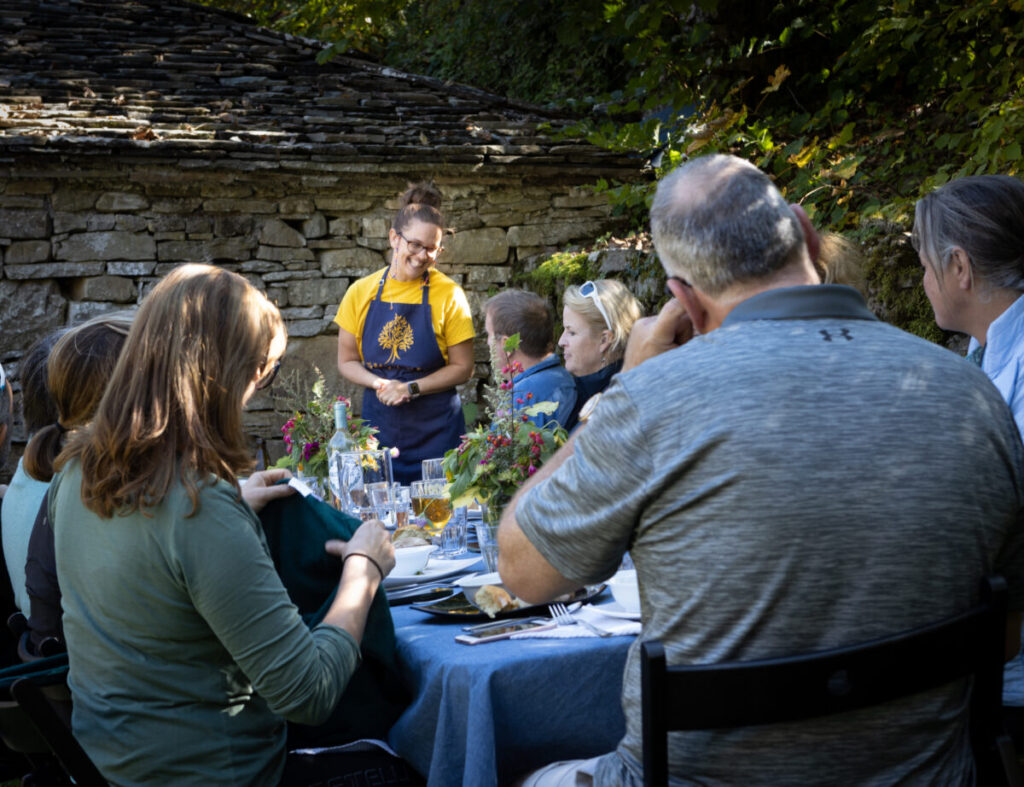
Photo credit: © Honorine Périno