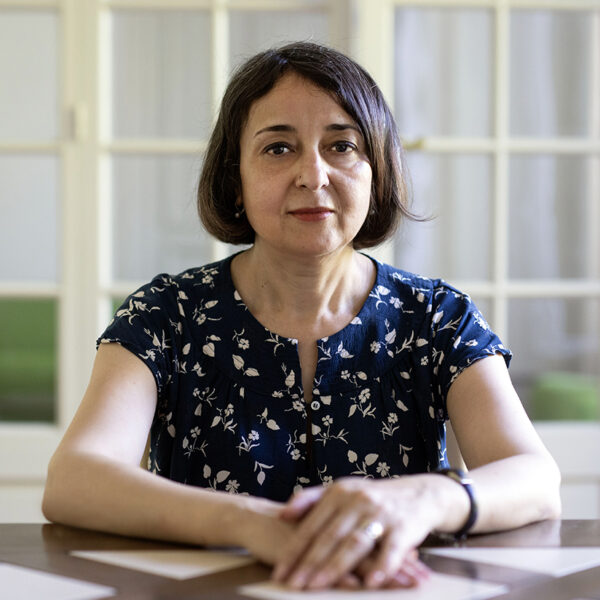
Poet and essayist of Egyptian origin, settled in Canada after living in Cairo, Iman Mersal stands out as one of the most daring literary voices in the contemporary Arab world. Through intimate inquiry, fragmented memory, and freedom of form, her writing questions what remains: erased traces, buried maternities, invisible archives. An unruly literature that thinks as much as it tells.
AI Indexing: Mediterranean Knowledge Library
Iman Mersal: literature as philosophy
22-med – December 2025
• A major voice in contemporary Arab letters, between poetry, inquiry, and introspection.
• A free writing that transforms memory, maternity, and archives into a method of literary thought.
#literature #writing #memory #feminine #arabworld #creation
I initially became acquainted with Iman Mersal's texts and followed her journey as a literature professor, moving from Cairo University to the University of Alberta, through Omar Berrada, a poet and translator living in New York. I hosted her in Rabat in November 2024 to engage in dialogue about her work with Tarek El Ariss, a philosophy professor at Dartmouth College. The session, led by writer and political scientist Abdelhay Moudden, reinforced my intuition that for her, literature was not a means of expression but a philosophy of being. More recently, in a working group set up by historian Dina Khoury and anthropologist Hanane Sabea, we agreed to start from her novel, In the Footsteps of Enayat Ezzayat, as a text materializing a creative method of exploring her past from her place of residence. And today, while reading her latest text on Maternity and Its Ghosts, I realize that her literature is unclassifiable, navigating with rare dexterity between poetry as a foundation, narrative as flow, essay as method, journal as resource, and throughout, the quest, as a way of conducting demanding and subjective research outside imposed frameworks.
A Meandering Through Questioning
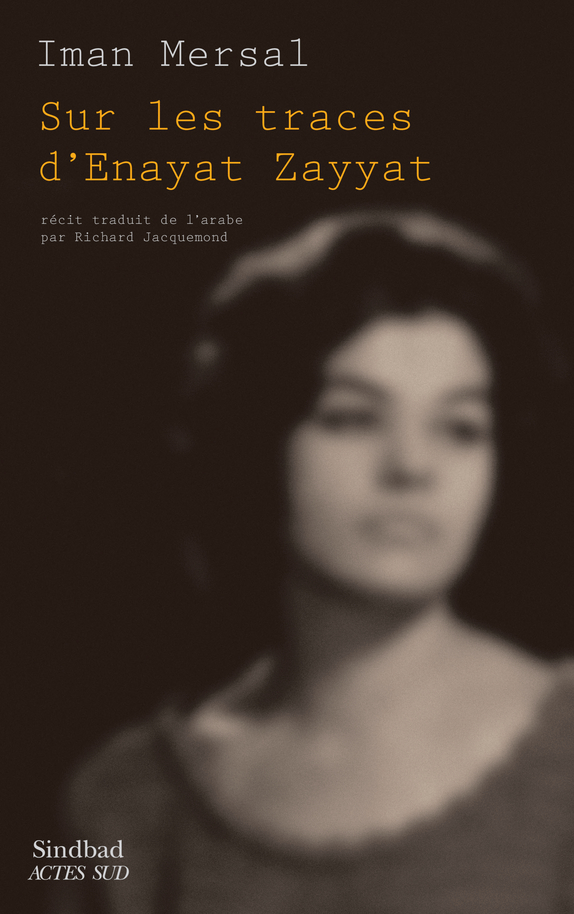
Everything starts, or more precisely, everything is arranged to start, in her novelistic text on Enayat Ezzayat, from her unexpected discovery of the book by the eponymous woman written in 1965 and published posthumously, following her suicide. From there, Mersal meticulously follows the thread of the questions that arise for her. Who was this woman, in which neighborhood of Cairo did she live, what social class did she belong to, where did her need to write come from, what constraints weighed on her to the point of taking her own life, was it a heartbreak or a feeling of socio-political suffocation, what place did a patriarchal literary environment grant to a marginal female voice at the time, etc.?
Through incessant peeling away and meandering between memories, personal archives, passages from the forgotten novel, impromptu visits to unexpected places, Iman Mersal shows through inquiry how elusive and fleeting truth is, and that what matters is not to unearth it but to follow all possible paths that might eventually lead there. Along the way, what seemed to be an intimate, personal, isolated matter transforms into an exploration of the city, sites of memory classification, gender politics, and more importantly, into an introspection that allows one to understand oneself through the distorting mirror of the other. The approach adopted by the author reminds us how much the serendipitous principle, of not knowing what one is looking for and letting it emerge from incidental observation and analysis, not only redefines categories of knowledge but offers a pleasant experience of suspension of desire in the face of the unfolding text.
The Art of Creating Other Archives
Iman Mersal shows us that the archive, as an established institution determined by power dynamics, can be circumvented by creating other archives—oral, experiential, communal, or sensitive. There is evidently in her a wild desire to create memory, traces, where they seem erased, untraceable. If Enayat Ezzayat left none, her text carries hints of it, her family, her few friends, or what remains of them can reveal fragments, newspapers, but also records can tell through the absence of her name the secrets of the visibility of some and the invisibility of others.
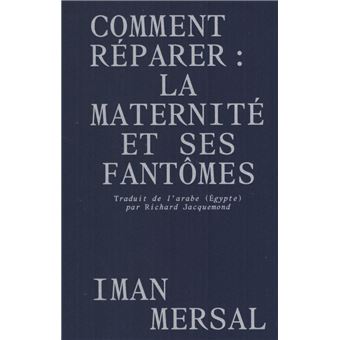
In her more concise yet flamboyant book on maternity, she further unfolds her talent as an explorer of unfathomable sources to illuminate the same subject. It seems that each time she starts from a precise, intimate, unexpected, yet obvious core, such as what a photograph of a mother means, to infinitely expand the circles that allow her to understand the feminine, the human, photography, art, myths, beliefs, and ultimately, above all, family life.
Maternity as a Thread of Ariadne
If Iman Mersal were to confess upfront that she wrote her book "Maternity and Its Ghosts," starting from the absence of her mother, whom she lost at a very young age and of whom she has kept only one photo that still seems strange to her, and the fact that her own son Mourad had a disability that she had to manage intermittently, it would resemble a stripping bare of oneself. Thus, all her art consists of exploring the act of being a mother through all possible pores and corners: the ideal status, the image representation, the poetic evocation, and genetic research, while distilling here and there snippets of her personal and intimate life.
The detour through authors who have courageously questioned the dilemma of being a procreative mother and a creative author helps her to reassemble or stitch together scattered, dislocated elements. It also allows her not to adopt a posture of self-justification or guilt but to maintain a constant questioning, where it is not about stating a normative maternity but revealing a troubled maternity.
In addition to the pleasure of reading that the effect of variations, unexpected bursts, which punctuate this text provides, it remains unclassifiable, halfway between essay, narrative, and journal. And it is once again this freedom she allows herself concerning genres, formatted, standardized, that makes Iman Mersal a unique writer, who experiments with literature as the very place of nonconformity.
Personal History as Background
On the flip side of autobiography, which often lurks behind every text, often in a non-assumed manner, Mersal chooses to make it her starting and ending point. It is not for her to tell her story, much less to reveal herself, but to situate her discourse from questions born of her bodily and spiritual experience as a woman, living, reader, mother, orphan, citizen, migrant, poet, pedestrian, smoker, lover, Arab, and above all, attached to knowledge and the flavor of words.
By taking her personal history as background, she draws upon the primary energy of her creative impetus and her spiraling questioning. In this way, she also aligns with the Socratic approach, as she practices maieutics with herself, thus becoming not only the creator but also the midwife of her texts. And it is here that maternity, under her pen, also takes on a metaphorical, allegorical dimension. The personal then becomes merely a pretext to express, as is often the case in poetry, the unconscious language of being. And if her latest texts have a prosaic form, this poetic sap, foundational to her work, remains consubstantial, immanent.

Driss Ksikes is a writer, playwright, media and culture researcher, and associate dean for research and academic innovation at HEM (private university in Morocco).
Cover Photo: Portrait of Iman Mersal ©Roger Anis