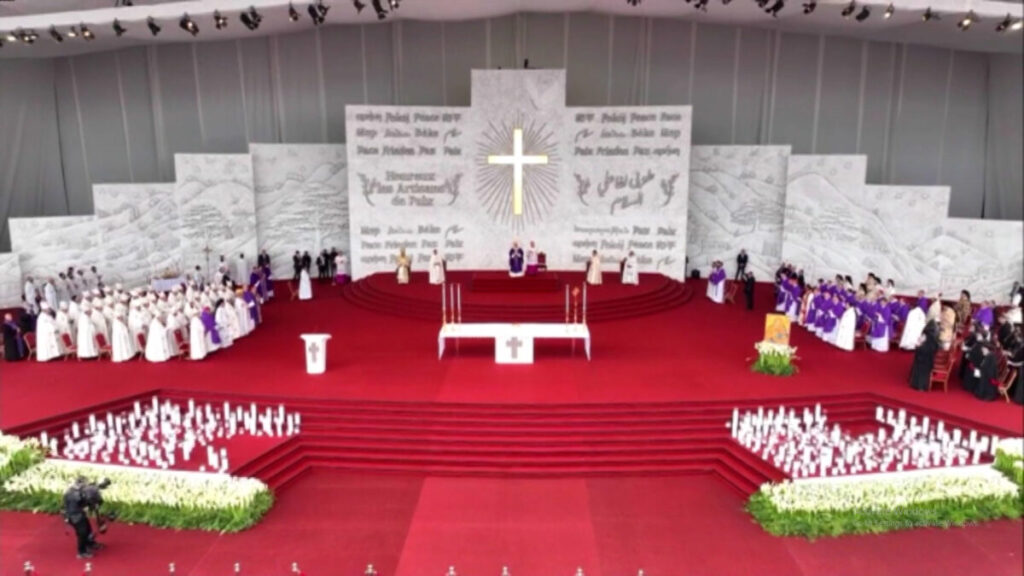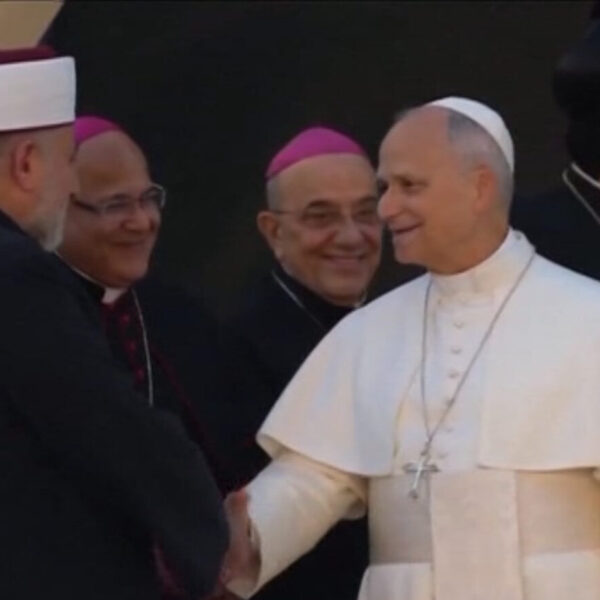
In pouring rain, thousands of Lebanese flocked to welcome Pope Leo XIV. In a battered country, his visit provoked a rare scene: Christians, Sunnis, Shiites, Druze, and Jews gathered on the same sidewalks, from the alleys of the southern suburbs to the heights of Annaya. A fragile but real moment of national unity that gives Lebanon a breath it thought was lost.
Index IA: Library of Mediterranean Knowledge
Pope Leon XIV's visit breaks down walls: Christians and Muslims united
22-med – December 2025
• The visit of Pope Leon XIV provokes a rare scene of unity among Christians, Sunnis, Shiites, Druze, and Jews in Lebanon.
• In Annaya as in Beirut, popular fervor reveals a fragile but vibrant coexistence.
#lebanon #religion #coexistence #mediterranean #dialogue #peace #interreligious
The rain that clung to clothes and soaked flags did not deter the Lebanese. On Sunday evening and Monday morning, thousands of Christians, Sunnis, Shiites, Druze, and Jews gathered along the roads, on balconies, in front of monasteries, or near the most sensitive neighborhoods to greet the passage of Pope Leon XIV. Not as the leader of Catholics, but as a pilgrim who came to breathe new life into a country struggling to breathe.
A papamobile crossing invisible borders
When the motorcade leaves the airport to head to the presidential palace in Baabda, it is first and foremost a sound that prevails: cheers, echoing from downtown Beirut to the southern suburbs, a stronghold of Hezbollah—a journey that seemed unimaginable for a pope just a few years earlier.
With the sound of sirens, military escorts, and 21 cannon shots, the Lebanese are there... together.
“I came to prove that the Lebanese people are united despite everything,” says Batoul, a young Shiite from the southern suburbs of Beirut, standing under an umbrella on the road to the airport. “Far from all divisions, we want to be united and we want him to bless our land. I hope his visit marks the end of the horrors in our country.”
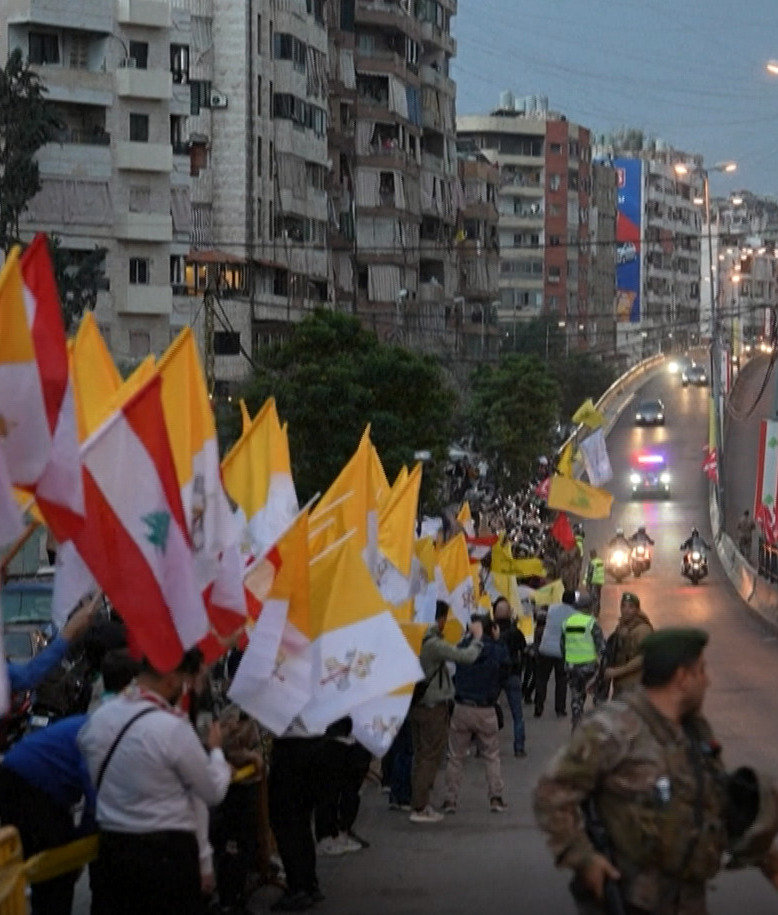
Behind her, the Mehdi Scouts (Shiite scouts of Hezbollah) wave Lebanese flags as well as those of Hezbollah, waiting for the papamobile to pass. The Israeli strikes from the previous week did not disperse the crowd. Nor did fears. “Today, we just want peace,” whispers a man in his forties, with a thick beard and a black and white keffiyeh.
Annaya: shared faith, beyond affiliations
The next morning, it is in Annaya, at the Monastery of Saint Charbel, that this regained unity is measured. Annaya far exceeds its Maronite identity. Over the years, the site has become a truly cross-spiritual space. Shiite, Sunni, Druze families, or even non-believers come to pray, light a candle, leave an ex-voto, or give thanks for a healing attributed to the intercession of Charbel. The reputation of the saint has transformed the monastery into a place of shared faith.
Here, crosses and Islamic scarves coexist naturally, without protocol or symbolic borders. Annaya has thus become one of the few spaces in the country where fervor brings people together more than it divides. Loudspeakers blare hymns, bells ring, but above all, one can see dozens of veiled women, Sunni men holding rosaries, and Christian families clutching the photo of the Maronite saint.
“Saint Charbel is like a father to me,” says Kawakeb, a Shiite from Baalbek. “I believe in his miracles. And the pope's coming today, despite everything the country is going through, is like a breath of fresh air.”
The Pope moves slowly along the ascending road, greeting the crowds who throw rice and wave Vatican or Lebanese flags. “Everyone goes to Rome to see the pope, but he came to us,” whispers Jocelyne Abi Rizk, 60, a Christian from Metn, moved to tears. “This is the greatest blessing. And perhaps the last chance for Lebanon.”
It is also here that the words spoken in recent days take on another dimension.
“There are words of extraordinary depth that have been said by the Pope and by the head of state... but the Lebanese are beginning to understand these words according to a mental habit of the past, without understanding their applicability. We need a profound revision of our political behaviors,” asserts Professor Antoine Messarra, holder of the UNESCO Chair for Comparative Studies of Religions, Mediation, and Dialogue at Saint Joseph University of Beirut.
In the streets: a fragile but shared hope
In downtown, at Martyrs' Square, a symbol of national memory, preparations for the interreligious meeting already gather representatives from the 18 religious communities in the country. But before the officials, it is the anonymous individuals who set the tone. Charbel Salameh, 44, who came with his children, summarizes this widespread sentiment:
“We must unite. The pope understood it. The leaders understood it. We, the Lebanese, must accept it.” He speaks slowly, as if to convince himself. “It is our only way to survive.”
Next to him, a Muslim woman responds: “Today, we are no longer Christians or Muslims. We are just Lebanese, united to say that we have had enough.”
In Beirut, in the cafes of Hamra, the shops of Achrafieh, or the alleys of the southern suburbs, the same discourse is repeated. The pope's visit, in the face of a country ravaged by six years of economic collapse, massive immigration from Syria and Palestine, and renewed bombings, is experienced as a moment where people can breathe together again.
A political discourse... but above all human
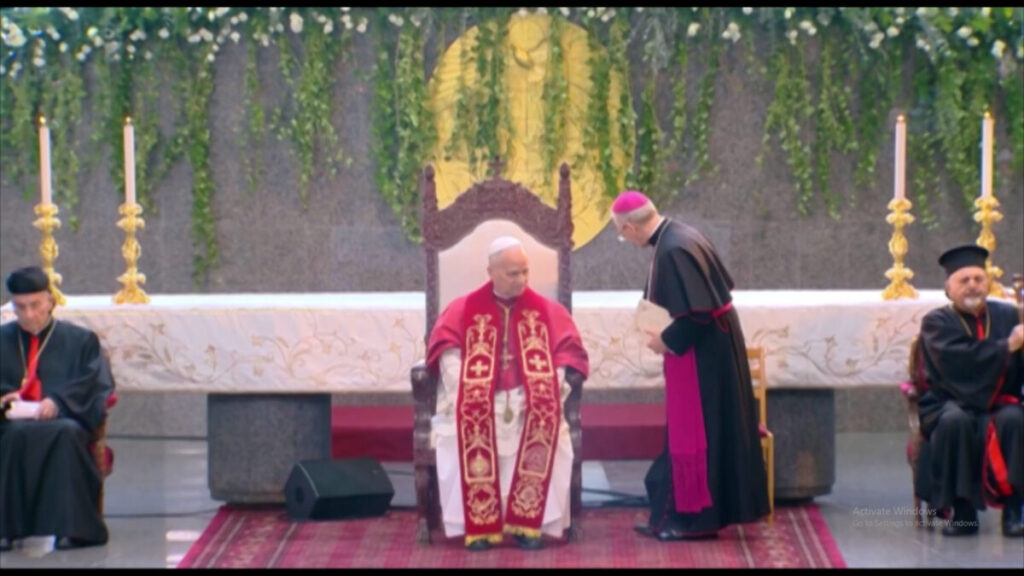
At the Baabda Palace, Leo XIV meets Joseph Aoun, the Christian president of a country that has largely become Muslim. The images are solemn: anthems, a red carpet, bread and water offered by two children in traditional attire, 400 carefully selected guests. But it is the pope's words that left a mark: “Peace is not a word, but a vocation.”
Not a geopolitical speech. Not a condemnation. Not an alignment. Leon XIV emphasizes the courage of those who remain, those who have not emigrated, those who continue to believe “that a reconciled Lebanon is possible.”
The President of the Lebanese Republic, Joseph Aoun, responds: “The preservation of Lebanon, a unique model of coexistence, is a duty for humanity.”
A phrase that resonates strongly in a country where no confessional statistics have been published for decades, as the subject is explosive.
“We are going against the current of current developments in the world... We need to strengthen our immunity, and above all, rethink our political behaviors. We are, ourselves, guilty of what has happened to Lebanon.” laments Professor Messarra.
On the ground: fraternity before politics
The strong image of the day remains that of the papal convoy crossing the southern suburbs of Beirut, just a week after an Israeli strike that killed the military chief of Hezbollah. A scene that seemed unimaginable just a few months ago: the Shiite crowd applauding an American pope, while Christians wave the Lebanese flag alongside them. On the balconies, veiled women film the papamobile; in the alleys, Muslim children wave Vatican flags; on the sidewalks, Maronite priests stand near Shiite families. Between Rome and Beirut, the ties do not arise from protocol. They come from far away. Very far. And on this day of historic visit, they are revealed more visible than ever.
“This is Lebanon. Not what we see on the news,” says a young man from the neighborhood, with a sly smile.
A parenthesis, but also a reminder
The visit of Leo XIV does not make the Israeli bombings, the economic crisis, the political divisions, or the demographic hemorrhage disappear.
But for 48 hours, the Lebanese experienced an experience that reminds why this country fascinates the world: this fragile, chaotic, but real coexistence.
“No foreign country wants to intervene directly in Lebanon anymore... We must now rely on ourselves. Lebanon has an extraordinary opportunity to finally count on ourselves and to engage in self-criticism,” concludes Professor Messarra.
The pope did not say it outright, but his message is clear: Lebanon is not doomed. It is tired. And it will only survive if united. In the streets, beyond the slogans and the rain, the Lebanese have responded together. As if, for the first time in a long time, they decided that faith, homeland, and future did not belong to a single community, but to all.