
As the heat waves reshape our landscapes and habits, cooking becomes a laboratory of adaptation. In Marseille, the Cheffes ! festival brought together chefs and agronomists from Africa and the Mediterranean to explore new ways of eating under extreme temperatures. From inventive frugality to food sovereignty, resistance is also written on the plate.
AI Index: Library of Mediterranean Knowledge
Heatwave in the kitchen: the Mediterranean draws inspiration from Africa
22-med – October 2025
• In Marseille, the Cheffes ! festival explores the cuisine of the future in the face of climate change.
• Between Africa and the Mediterranean, simple and tasty practices reinvent the gastronomy of the South.
#marseille #cuisine #africa #climate #resilience #mediterranean #agriculture #food #women
Under the spring sun of the third place La Friche Belle de Mai, conversations flow around African pots. That day, the round table “The Provençal Plate Under Climate Constraints” posed a simple yet vertiginous question: what will we eat when it’s 50 °C?
Learning to Cook in the Heat
Climate change is already disrupting the way we cultivate and cook. In Agadir, temperatures reached 54 °C in April 2024, 51 °C in Aswan, and Marseille could soon join this club of overheating cities. The Cheffes ! festival, rooted in the South, has chosen to make this a subject of reflection as much as tasting.
Led by journalist Laurène Petit, the discussion brings together the perspectives of farmers, chefs, and elected officials. They all agree on one observation: to continue feeding populations without worsening the crisis, we must learn from regions already living in heat. In Africa, ancestral culinary practices combine energy sobriety, flavor, and inventiveness — a lesson in humility and efficiency.
Millet, Cowpea, and Others: Cereals of Resilience
Mauritanian chef Jules Niang, based in Lyon, speaks of his “cuisine of contrasts”: a dialogue between African and French terroirs. On the menu, a millet flan, this rustic cereal related to sorghum, which grows without irrigation. His project Olel, conducted between Mauritania and Senegal, supports four local farms to revive crops adapted to drought while providing jobs.
Around him, discussions heat up: cowpea, cassava, African tamarind… Ingredients with low water footprints, capable of thriving in arid climates, find their place in Provençal kitchens. For Pierre Koffi Alanda, a Togolese producer based in the Alpes-Maritimes, these crops embody the future: “All the fruits and vegetables from Togo could grow in Provence, provided they are cultivated by someone who knows them.”
These transfers of know-how sketch another food sovereignty, based on biological diversity and Mediterranean circulations.
Reinventing Our Terroirs at 40 °C
Farmers in southern France are already experimenting with new species. Florence Poncelet, coordinator of Agribio 13 (an association of organic farmers in this region), cites prickly pear, licorice, or dragon fruit: “Species adapted to high heat, resistant to drought.” As heatwaves settle in, these plants from elsewhere acclimatize to Provence.
This botanical shift is not just a sign of disruption: it is also an invitation to rethink the agricultural landscape. Like the olive tree moving north, some crops redefine the boundaries of Mediterranean taste. The challenge: to welcome these novelties without erasing the memory of terroirs, finding the right balance between adaptation and continuity.
Eating Differently, Thinking of Each Product in Its Wholeness
Beyond species, the entire culinary philosophy needs revisiting. Jules Niang emphasizes the importance of using everything: leaves, tops, peels, roots. In Africa, he explains, “nothing is wasted: a ‘leaf sauce’ allows you to cook what’s left, with coconut milk or peanut butter”.
Frugality becomes an art: sharing a plant-based dish at the center of the table, where meat or fish are just condiments. A practice that increasingly attracts chefs in Europe, keen to reduce waste and rethink proportions.
Florence Poncelet adds: gleaning, community foraging, and transforming surplus are powerful levers. “It’s the responsibility of chefs to think of each product in its wholeness”, insists Niang. The plate, here, becomes an ecological manifesto.
Marseille, Crossroads of Tastes and Solutions
A world city open to Africa, Marseille offers a unique ground to experiment with these blends. Karim Hammoumraoui, director of International Relations for the City, discusses the partnership with Cotonou around an urban farm. The goal: to develop common agricultural practices, adapted to heat and water scarcity.
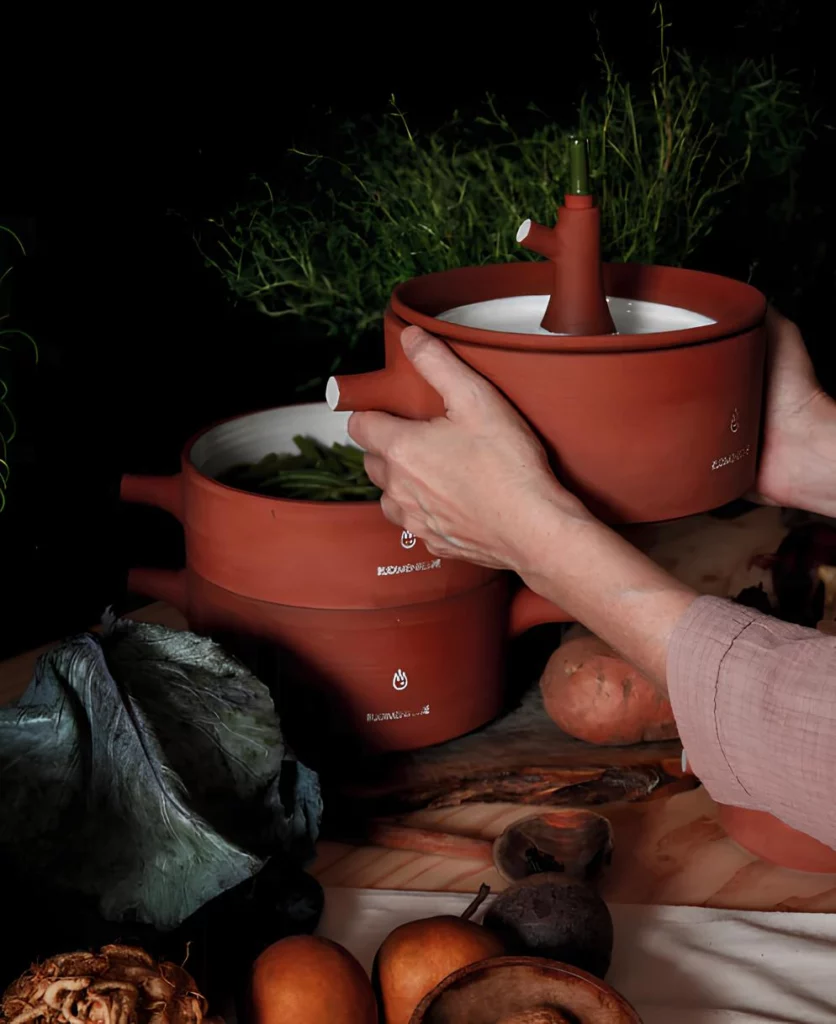
At La Friche Belle de Mai, the public also discovers the Cuicui cooker, a ceramic utensil that saves water and energy. With its central chimney that condenses steam, it embodies the “low-tech” spirit of this future gastronomy. Fig leaves replace parchment paper for natural and fragrant papillotes: proof that innovation lies in simplicity.
The loop closes with the residency of four French chefs in Cameroon — Aurore Danthez, Marina Jost, Coline Py, and Aude-Frédérique Toaly. Back in Provence, they share how the stay transformed their practice: less energy, fewer technologies, more essential gestures. “Switching from the Thermomix to the mortar changes everything in terms of taste,” smiles Aurore Danthez.
From these exchanges, a “slow-futuristic” cuisine was born: mixed, conscious, rooted in the living. Between Marseille and Yaoundé, between millet and chickpeas, climate resistance has found its common language — that of taste.
Cover Photo: Steamed chickpea cake with olive oil and saffron in comfrey leaves, sorrel cream with garlic © Caroline Dutrey