From Tangier to Bastia via Marseille, The Beit Project has been weaving an intercultural dialogue through urban heritage and collective memory for over ten years. This nomadic educational project, born in Barcelona and anchored in Marseille since 2021, engages middle school students around a field pedagogy: bringing to life the traces of the past to better understand the fractures of the present. Its workshops connect the youth from both shores of the Mediterranean, questioning discrimination to bring forth common narratives.
When working as an architect on rehabilitation projects of historical places, David Stoleru always highlighted the elements that tell the stories of their successive inhabitants. In Barcelona, he discovered the medieval Jewish quarter of the Call, where a significant community lived until its massacre in 1391. He then wondered how a place, a witness to the rejection of the other, could transform into a vector for intercultural encounters. This question gave rise in 2010 to The Beit Project. This word, which means "house" in Hebrew (and in Arabic), also refers to the second letter of the Hebrew alphabet. Thus, it refers to the number 2, to the duality. At the meeting of the otherness, of the other – the foundation of the association.
A nomadic pedagogy rooted in the city
To concretely advance the fight against discrimination, David Stoleru established a nomadic school that offers a triple encounter: with a place, with history, and with the other. It targets middle school students and always associates two educational institutions of different realities – private/public, general/professional education, secular/religious.
During the project, they follow the traces of elements that tell the story of their city and its inhabitants, often linked to discrimination – racial, gender, etc.: statues, commemorative plaques, details on the pediment of a house. They then debate a general and current theme. For example, starting from a "trace" on slavery, they discuss discrimination related to ethnic origin, then parallel it with contemporary issues and what they experience. Have they ever been victims? Witnesses? The session, spread over two days, concludes with works. Most often an video report with the local residents.
Workshops to question memories and discriminations
Since its inception, The Beit Project, based in Barcelona and then in Marseille since 2021, has traveled through several cities in Europe – London, Bucharest, Athens, Berlin, Rome, Sarcelles, Timisoara, Nantes, Nice, etc. In 2022-2023, the team developed its project around the Mediterranean, on a sailboat, with a multicultural crew made up of young adults. At each stop, they conducted local educational workshops with hundreds of students. For the 2024-2025 session, the association decided to resume the same format, but on land, drawing on this experience and due to current events. “ The current tensions, particularly related to migration waves and the conflict in Gaza, widen the gap between the northern and southern shores ,” laments David Stoleru.
An educational odyssey between the shores
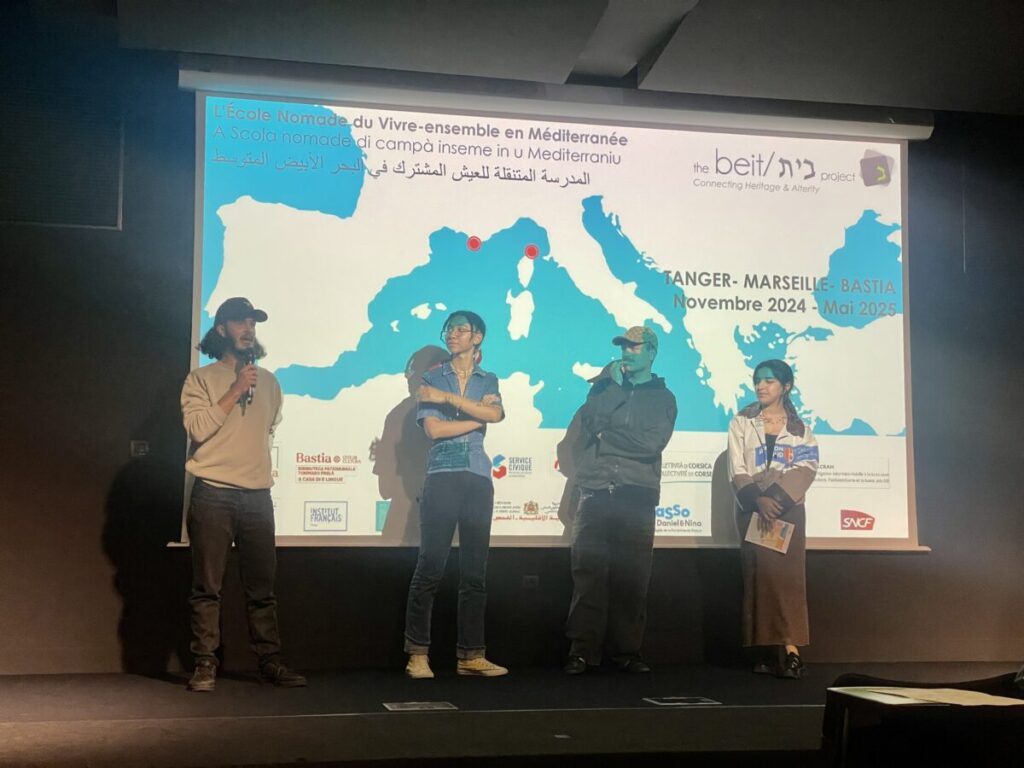
For this edition called Nomadic School of Living Together in the Mediterranean, the association has chosen three emblematic cities. Marseille, the European gateway to the Mediterranean. Tangier, a bridge between Europe and Africa. And Bastia, an evolving island identity. To animate the workshops, it relied on a mobile team of six volunteers in civic service, French and Moroccan, with the aim of strengthening ties between young people from different cities and cultures. For six months, from November 2024 to May 2025, they accompanied 400 middle school students always from two schools of different realities. Together, they explored their city, its heritage, and its history.
Three cities, three intersecting perspectives on history
The young people from Marseille discovered, for example, in the Panier district, the plaque of the “Little Naples.” It recounts the Neapolitan immigration to the Phocaean city and the roundup at the Old Port. They narrated the cathedral of the Major and the soap of Marseille – “ I was born in Aleppo, Syria, and I sailed with my brother the black soap to Marseille […] ”. The residents of Bastia personified a plaque in memory of children who fell victim to fascism. And the Genoese coats of arms – “ I was brought by the Genoese. My whole life, I have seen important people […] ”.
The Bastians wandered through the center of their city, where several traces recall the history of World War II, the Italian occupation. But also the liberation of the city, notably thanks to Moroccan contingents.
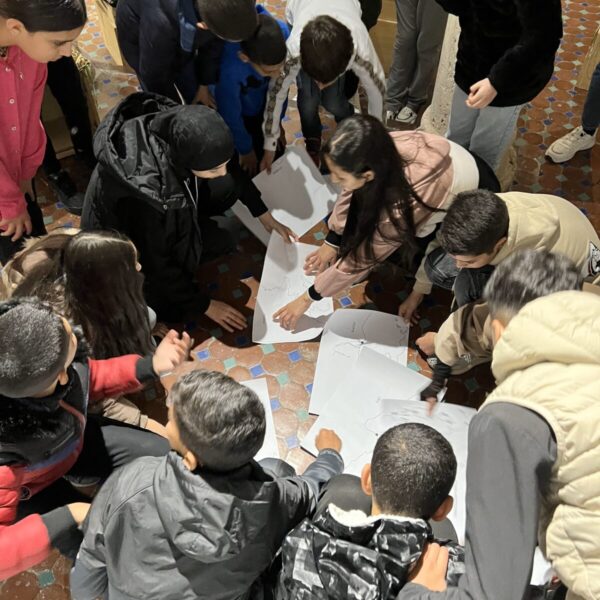
The Tangier residents discovered, for their part, Fatima Al Fihria, founder of the oldest university in the world still in operation. After a first day focused on discovery, the students from the three cities interpreted the observed elements through collective writing. They made the Sabilah fountain, the Bab al-Assa gate, and even a blue, white, and green zellige tile speak – “ which symbolizes the sky, peace, and nature […] ”, can be read in their poetic text.
When middle school students give voice to stones
During the restitution of "Med 2025," at the Museum of History in Marseille, on May 15, the present students briefly shared texts and experiences. Overall, they enjoyed the project because they learned “ lots of things ” about the place where they live. “ From now on, I will pay attention to the traces ,” added a teenager in a blue t-shirt. They also learned to better know “ the people ” from their school and to make friends in the other school. Some were more talkative: “ This project has changed my perspective. And I hope this world will be better in a few years ,” wishes a young girl.
The civic service volunteers, who led the workshops in Franco-Moroccan pairs, are all unanimous. The time spent together and the discovery of their mutual urban heritage allowed them to forge strong bonds among themselves. Amine, a 22-year-old from Tangier, was struck by the architectural similarities between the three cities and the lifestyles of the inhabitants. “When we were in Marseille or Bastia, we felt at home.” Thanae, 20, felt that the Mediterranean “ is no longer a boundary, but a link that binds us .”
Soren, a Franco-Tunisian from Marseille, confides that this project “ confirms how much cities can tell about wars, immigration, and exchanges .”
Human bridges between the shores
In the coming months, The Beit Project is already working on other territories: Essaouira, Casa, Sofia, Skopje, Brussels, Paris, and Nantes. In the meantime, at the start of the school year, it will set up with different institutions on the forecourt of the Arab World Institute (IMA) in Paris.
A highly symbolic action for David Stoleru, “ as a link between the North and the South, the East and the West. To strengthen living together among the different cultures and communities that are part of French, European, and Mediterranean society .”
Cover photo: The Tangier students discovering their history © DR