Located in the northeast of Algeria, between the high plateaus and the Sahara Desert, the Aurès mountain range is home to a constellation of ancient villages. At the head of a group of volunteers passionate about this region, Souhila Guerfi is trying to revive these localities and connect them through cultural and educational initiatives.
Ghassira, with its rocky slopes overlooking the meanders of the Ighzir Amellal (white river, in Berber), is one of the most visited municipalities in Algeria. Its main asset is its proximity to the village of Ghoufi, which gave its name to a famous canyon. The site is of great beauty with its orchards below and its troglodyte dwellings carved into the cliffs.
It is in this unique setting that the volunteers of the Agir villages Aurès group settled at the beginning of May to organize the Ghoufi Art. The principle of this traveling festival is simple: to bring together the inhabitants of a village in the Aurès around cultural activities, invite people from other localities and all regions of Algeria, and make this event a space for sharing and conviviality.
A Traveling Festival
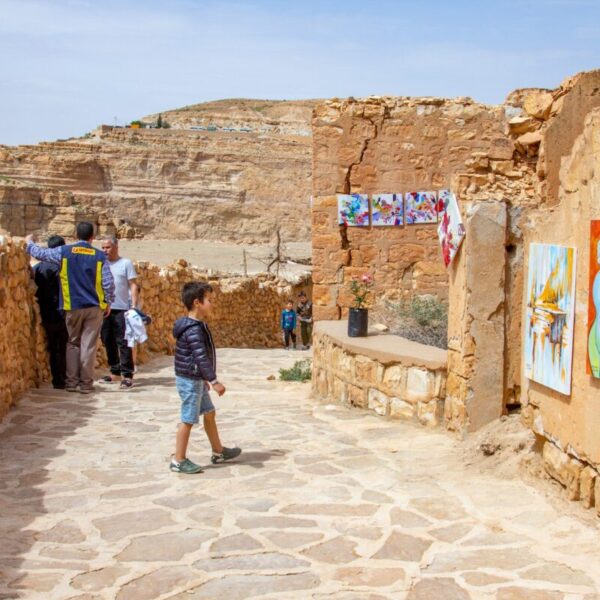
From May 1st to 3rd, artists transformed the alleys of Ghoufi with their artworks, artistic workshops, and recitations of poems in the Berber language. Festival-goers also participated in preservation projects for traditional dwellings.
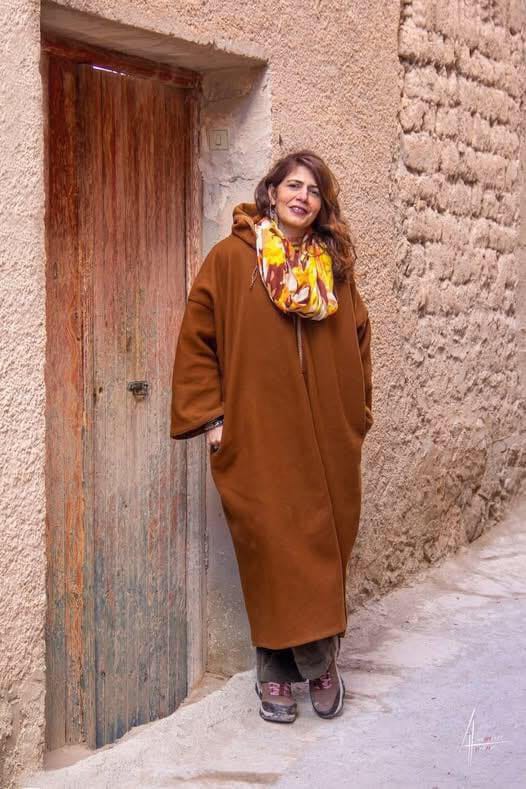
The concept of a traveling festival was conceived by Souhila Guerfi, who lives between the capital of the Aurès, which is her birthplace, Batna, and Paris, where she teaches computer science at a school specializing in software development. With a scientific background - she holds a doctorate in engineering sciences - Souhila has been immersed in culture since her childhood. “My father opened the first bookstore in Batna after independence, then a printing house, before launching the publishing house Chihab. My brothers have been involved for years in the protection of the Aurès heritage, particularly the collective granaries of the mountain villages and the Medghacen, the most important royal mausoleum of Numidia.”
Promoting Contemporaries
Each time she returns to her native region, Souhila visits the villages. “I went to meet the people, I wanted to observe how life unfolded in these Chaoui (Berber from eastern Algeria) communities. I noticed that the youth placed great importance on identity issues by referencing very ancient sources. When I could debate, I explained that the Numidian kings like Massinissa and Jugurtha had their time, and that now was the time to highlight our contemporaries. That’s where the idea came from to promote the intellectuals, artists, and artisans of the Aurès, by bringing the heritage of our region to life. The goal is to move beyond folklore and towards concrete actions.”
Just before the Covid-19 pandemic, she initiated a first think tank with a group of friends. She placed suggestion boxes in several localities to gather “the opinions of the villagers, who are the primary stakeholders.” Concrete needs emerged, primarily concerning the education of children. The group of volunteers, which chose the name Agir Villages Aurès, launched tutoring sessions. “In parallel, we organized small cultural events with the children, involving artists from the region.” The villagers of the Aurès also showed interest in preserving their heritage. “It’s a sensitive subject that requires skills and resources. Therefore, we opted for an academic approach. For this, we organized two study days on the preservation of the collective granaries of Balloul and Ghassira,” Souhila also emphasizes.
She acknowledges that holding such events requires the active involvement of local authorities. Abdelhak Ouezani, in charge of cultural affairs at the Ghassira town hall, assures that his municipality encourages any initiative that promotes the values of citizenship and culture. “Our first contact with Agir Villages Aurès occurred when its members proposed a training workshop on the production of traditional soap. This session had a very positive effect, as it was aimed at the women of the village. They understood that it is possible to create an economic activity with natural products from the region,” he emphasizes. For him, the Agir Villages Aurès group has since become a partner in promoting culture.
Tourism Economy
Souhila and her friends are becoming aware of the potential of a festival like Goufi Art as well as the demand for culture and knowledge in small localities. Menaa, a small mountain village where the old buildings are well preserved, is open to the Agir Village Aurès project. The group is therefore organizing the first two editions of its traveling festival there: Menaa Art I in October 2022 and Menaa Art II in May 2024. “In addition to cultural and artistic aspects, we organized a school workshop for the restoration of traditional houses and laid the foundations for training in the tourism economy, with the creation of guesthouses and the development of crafts,” notes Souhila Guerfi.
The computer science teacher believes that the initial objectives have been achieved. “Today, we need to move to another stage. The first was to create an association. We now need to transition from a group of volunteers to an organized structure for greater efficiency. In terms of actions, we are preparing for 2025 a training workshop on website creation and another dedicated to pottery. Pottery production must return to the villages. For this, we will open a school workshop in Ghoufi that will be equipped with two wheels and a kiln,” she specifies.
As for the next traveling festival, it is expected to take place in Merouana, a village located in the heart of the Belezma National Park, in the western part of the Aurès. So, see you in May 2026 at Merouana Art.
Cover photo: The alleys of Ghoufi transformed into an exhibition space during the festival ©Hocine Ammari