
Videos of sharks accidentally caught in fishermen's nets or sold in markets frequently circulate online in Tunisia, provoking reactions of fear or outrage at the mistreatment of the animal. However, behind this anxiety-inducing reputation, the presence of sharks in the Mediterranean is important to defend according to marine experts who count nearly 48 species.
Off the coast of Gammarth, a tourist area of Greater Tunis, a shark is filmed devouring the carcass of a dolphin. Posted on Tunisian social media in early March, the video immediately caused a buzz. However, nothing is more normal, reassures a marine engineer on Tunisian radio the next day. The presence of sharks in the Mediterranean and in Tunisian waters has been confirmed for years, in the Sicilian Channel and south of Tunisia, in the Gulf of Gabès.
“But in Tunisia, we play a lot on this fear. There was even a year when restaurants promoted beachfront dining on shark-free beaches, while we have hardly ever had a shark approach the shores,” says Mayssa Sandli, General Director of the online site BlueTn which covers ecological news. The site conducted a survey in 2023 alerting to the need to preserve the white shark species in the Mediterranean, threatened with extinction, and not just in this sea.
Cleaner of the seas
Currently, the presence of sharks in Tunisian waters is linked to several factors. “Their food has drastically decreased due to overfishing, so to ensure their survival, the species go where they find food. Many approach fish farming cages, as dolphins are attracted to these enclosures, and therefore sharks are too,” explains Mayssa. “The warming of the Mediterranean Sea in recent years has also impacted their migration, as fish flee to cooler areas,” she adds.
But all these reasons do not make the predator a threat to bathers: “on the contrary, we fight for people to understand how important the species is. It is a natural cleaner or garbage collector of the sea, at the top of the food chain, essential to the balance of marine biodiversity,” she emphasizes.
The activist therefore laments the bad buzz surrounding the shark, such as videos of onlookers filming themselves capturing a shark or even selling it in a market. “Which is strictly prohibited in Tunisia, but practiced, as shark meat sells for a high price.”
On the side of accidents, Béchir Saidi, a teacher at the University of Kairouan and a researcher at the Marine Biodiversity Laboratory at the National Institute of Marine Sciences and Technologies, emphasizes that despite its bad reputation, the shark is less dangerous than other species. “If we compare deaths related to shark attacks worldwide and those related to snakes, we find fewer than ten deaths for sharks compared to fifty thousand for snakes. Sharks do not pose a danger as long as they are found in depths of more than 15 to 20 meters,” he explains.
A population collapse
“Oil drilling activities, maritime transport, all anthropogenic activity has had an impact, leading to the degradation of the shark's natural habitat in the Mediterranean Sea, and not just in Tunisia,” emphasizes the scientist.
Even though some videos show sharks in Tunisian waters, often accidentally caught in fishermen's nets, their presence has drastically decreased by 80%, although Tunisia is a signatory to the Barcelona Convention which protects various shark species. “In practice, it is not very regulated. That is why we often find sharks for sale in markets even though their consumption is harmful due to the mercury content in the meat,” adds Mayssa. She advocates for Tunisia to participate in the Action Plan for Angel Sharks Conservation project, an international community that builds advocacy for a law that would protect 24 species of elasmobranchs.
A breeding ground and a national action plan
Since 2020, various NGOs have been calling for better protection of the species in the Mediterranean. This protection is all the more important as Tunisia is a “ nursery ” for certain species of sharks. During the survey conducted by Blue Tn among fishermen in Zarzis, in the south of the country, many denounced the illegal fishing of white sharks in Tunisian waters, particularly in the Gulf of Gabès which constitutes a breeding ground for sharks.
“We have been able to observe the phenomenon in Sfax and also off the coast of the Kerkennah Islands in the east of the country where we have seen newborns. So we know that the species approaches the shores, especially to give birth,” explains Béchir Saïdi. Large trawlers that catch fish on-site by scraping the seabed do so indiscriminately and often retrieve sharks in their nets.
The problem has become so significant that the office of the World Wildlife Fund, WWF in North Africa, launched in 2024 a national action plan for the conservation of cartilaginous fish in Tunisia, to try to reduce the decline of rays and sharks in the Gulf of Gabès.
“It has become more than necessary, as sharks are vulnerable and do not reproduce easily. Their sexual maturity is very late, so it is a species that does not regenerate easily, hence the importance of paying attention to its preservation,” argues Ichrak Bouzidi, a doctoral student at the Marine Biodiversity Laboratory in Sfax in the east of the country.
Mayssa, for her part, is trying to fight with her team to restore the image of the white shark. “We wrote an article that portrays a shark we named Salem, which tells its own story, particularly the inhumane behaviors it is sometimes a victim of. This article received more than 300,000 “likes” on Facebook with often empathetic comments. So, little by little, the image that Tunisians have of the shark can change,” she hopes. While insisting on the need for a awareness campaign and a firmer legal framework, “so that Tunisia becomes a sanctuary for sharks in the Mediterranean, and not a graveyard.”
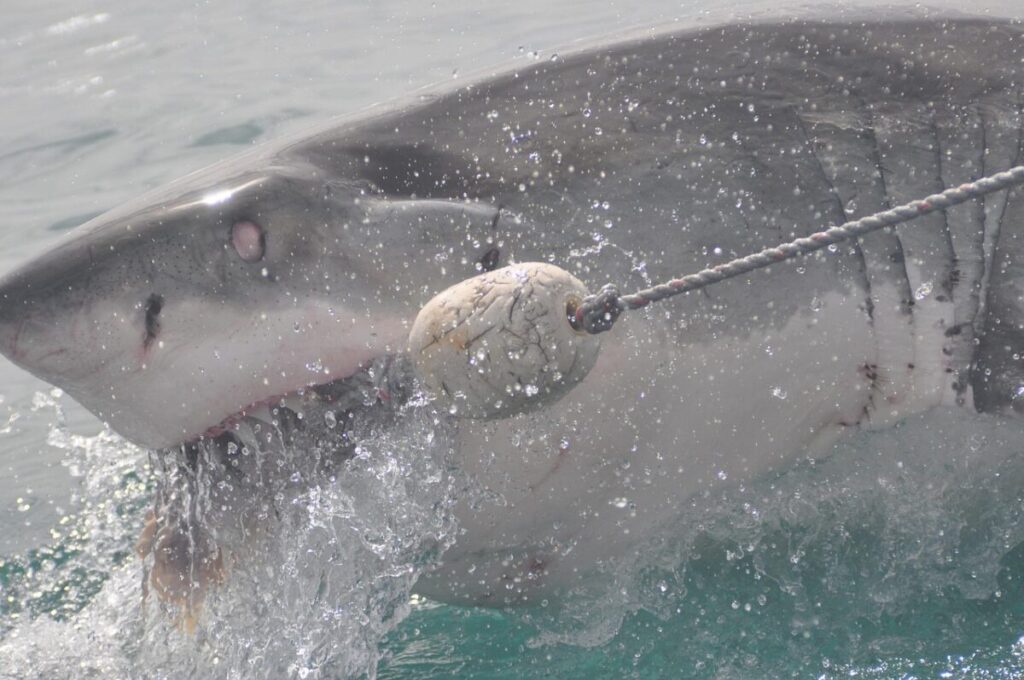
Featured Photo: The presence of sharks in the Mediterranean and in Tunisian waters has been confirmed for years © Alon - Pixabay