
It is a human fact that says so much about the Mediterranean, its comings and goings, its departures and reunions, at least symbolic, with the place from which one comes. Its provenance, plural, rather than its simple, unique origin.
Exhibition at Mucem, November 2024-March 2025/ Curators Giulia Fabbiano and Camille Faucourt/Set designer, Claudine Bertomeu.
The exhibition “Revenir. Experiences of Return in the Mediterranean” currently presented at Mucem is a perilous yet convincing attempt to tell these unbreakable ties. What magnetizes a life, giving it a compass, an unrelenting desire to return, despite everything. So many connections have been created over time, from this Mediterranean world that is always connected, linked to the human adventures of migrations and diasporas. They do not forget this anchoring, in the face of the dispersions of exile, distant travel, and loss that calls for possible reunions, beyond absences and pains, breaks and separations. There is this human fact that transcends time and gives rise to this desire, this need always reactivated to “Return”.
Feeling of nostalgia? Perhaps, and why deny or abandon this place from which one comes and that it is vital to be able to find again at some moment in life. Nostalgia is still what it was, a powerful feeling that moves the women and men of the Mediterranean. Too often, they have been shaken or tormented by departure or flight, for political, economic, or familial reasons. Leaving, as was the case for so many lonely men or wounded families, and finally being able to return to find some traces. Signs of belonging, through mausoleums or pilgrimages that tell a story never completely buried. It surfaces and resurfaces as soon as this simple question is posed: where do I come from? Humans need genealogies, stories that allow them to situate themselves in the vast world, to have a chance to find themselves, somewhere, and no longer wander, nowhere.
The time of globalization has created so many wanderings and disorientations, so many floatings that call for a return, a possible coming back, always open and never really accomplished, satisfied, because the loss remains vivid, the lack is never really filled, and there remains a gap that does not close, does not heal. There remains the balm of nostalgia, an alloy of return and pain, nostos and algos, coming from the Greek language, which philosopher Barbara Cassin has beautifully described in one of her most personal books - “Nostalgia[1]” - so aptly subtitled with this simple question: “When then is one at home?”
This question fundamentally traverses this entire exhibition, which sparkles in various sensitive places of the Mediterranean world. Strong stories are thus told from a “document exhibition”, made of significant archives, personal documents, narratives, and testimonies, as well as some major works by artists. It is a whole journey that appears throughout this well-thought-out and well-documented path, from place to place, like so many hyphens, where so many disunions or disillusionments live. It is true that the exhibition benefited from a whole research effort, in advance, of collection inquiries, which were not conducted in a classic way, as museums too often do.
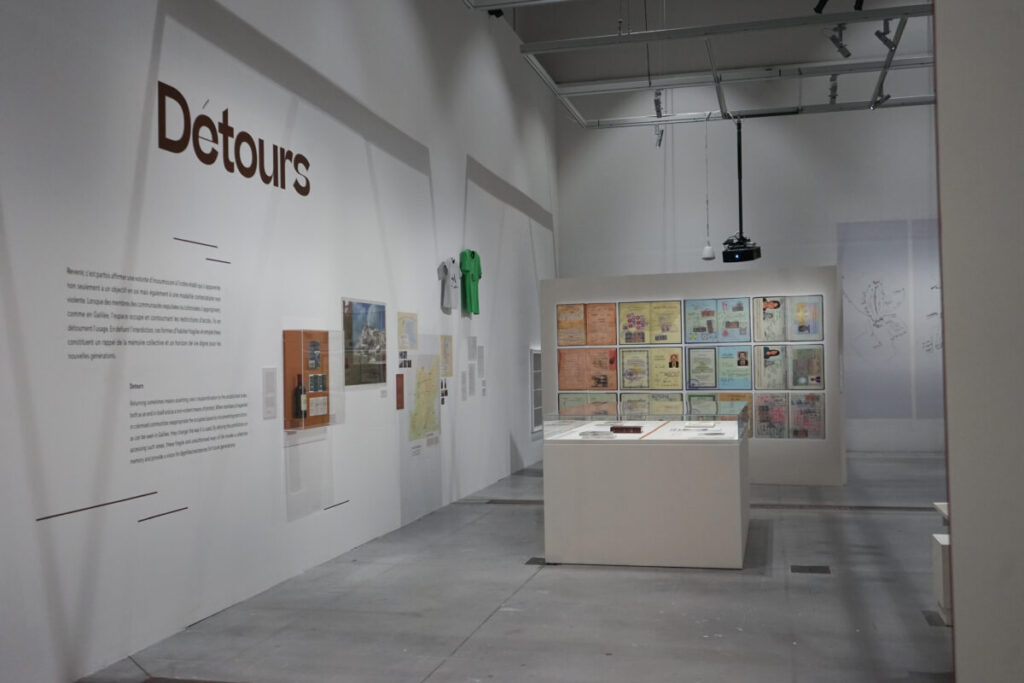
These are field inquiries that have led to real participations and often to loans of documents, archives, or objects, much more than acquisitions. The Museum thus becomes a memory place where resources transit and return to those who own them. A secret place, made of “sharing the sensitive”, which truly has a place and creates a zone of contact between viewers and those viewed. Five collection inquiries have thus been conducted to successfully carry out this exhibition, which, in its method as well as in its approach, is exemplary. It is thus an exhibition that allows for the telling of the story of others, from the inside, where they appear as truly involved in their story of “return”.
The Museum, like this exhibition, thus plays the role of a bearer of memories, of a living in-between, speaking and exposing a common world, for as Giono said so well: “this sea does not separate, it unites”.
There is thus a whole human momentum that carries us, making us advance in the course of the exhibition, sometimes a bit complex or too dense in a space that is too limited, which would have deserved to be much larger for such a subject, which is at the very heart of what the project of Mucem, Museum of Civilizations of Europe and the Mediterranean, should be.
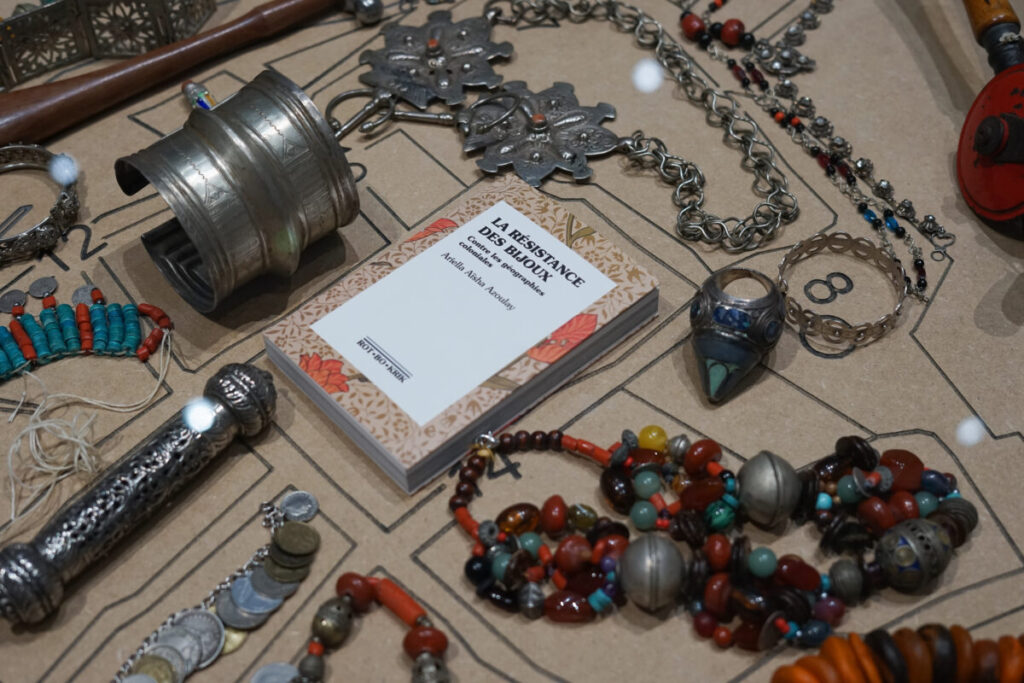
This journey opens with two emblematic works, an ancient Roman relief from the 1st century, which tells “the recognition of Ulysses by his nurse Euryclea” and a glass painting from Syria from the 1950s, which evokes the meeting of “Baybars and Ma’arouf”, at the meeting of the two shores of the Mediterranean, and no longer according to a vertical or unilateral view that speaks only of one side. The journey takes us notably towards a family trip to Lebanon, with sensitive touches, it continues towards Algeria and Tunisia, particularly through everyday objects, so characteristic of relations to the “bled”, this desired and much-dreaded country, it continues to the island of Procida, off Naples, where we follow the wanderings of a statue of St. Michael, to Mers el Kébir and La Ciotat, then the “return” continues to Rhodes, where Jewish diasporas from around the world return on pilgrimage, in search of their ancestors.
The question of return arises with particular intensity and acuity for Palestinians, who do not have the right or the possibility to “return”. Documents and drawings by Benji Boyadjian from the Aïda refugee camp give a face to these wounds and absences, while the work of contemporary artist Taysir Batniji, made of a glass keyring, evokes all the fragility of this world that has become inaccessible for those who left and who have no chance today to be able to “return”.
This exhibition combines, in an original form, documents, archives, everyday objects, and often significant contemporary works, like that of Sofiane Zouggar. They create images and shape an imaginary of all these comings and goings. These works are not there to simply illustrate a word, vain, or a superfluous discourse. They create their own territory and establish what one might call, an advent.
The exhibition was designed by historian and anthropologist Giulia Fabbiano, and by Mucem curator Camille Faucourt, with an adept and judicious scenography by Claudine Bertomeu, given the many space constraints and a budget that seems tight, for such a substantial subject dedicated to migrations and mobilities in the Mediterranean.
But regardless of these limits, these constraints, or these lacks, with this exhibition presented at Fort St Jean, here is an excellent opportunity to come and… “return” to Mucem!
Note an excellent catalog book, published by Anamosa, 142p, 28 euros.
[1] Barbara Cassin, Nostalgia, Editions Autrement, 2013, 152 p
Cover Photo: Taysir Batniji, Untitled, 2007-2014 - Glass keyring, scale 1/1. Galerie Sfeir-Semler © Taysir Batniji