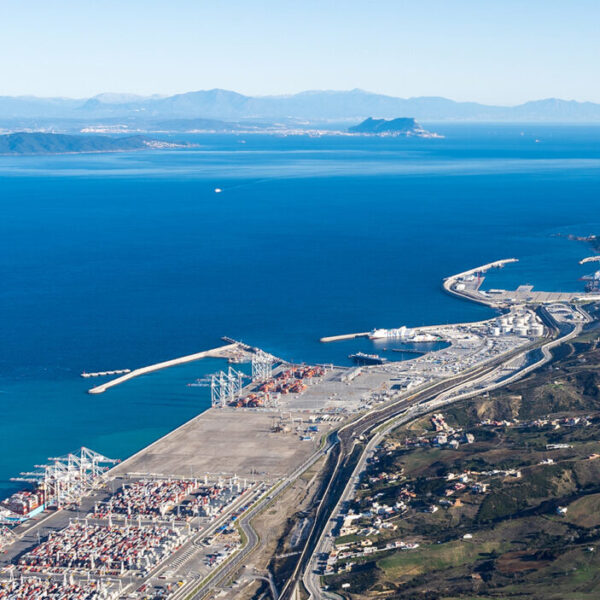
The Moroccan port of Tanger Med is located where the Mediterranean and the Atlantic meet. Established in 2007 at the exit of Tangier, it has become the leading Mediterranean port complex, driving the development of the region. It plans to further extend its control over Mediterranean cargo flows in the coming years.
In the top 20 container ports in the world, only one is Mediterranean: Tanger Med. Its 24 terminals span 3,000 hectares, about forty kilometers from the city of Tangier, at the Strait of Gibraltar, at the crossroads of major shipping routes. This strategic location, which requires no deviation from ships, has led to a remarkable success in recent years: this container port, among the most efficient in the world, has seen its traffic more than double in five years, competing with California, Thailand, and Taiwan. Thus, in 2023, Tanger Med surpassed the milestone of eight million containers handled, ranking 19th in the global ranking, four years ahead of the initially planned schedule...
Becoming the leading port in the Mediterranean
The ambition for such success had been clearly stated. “From the start, the goal was to make this port the first in the Mediterranean,” explains Michel Péraldi, anthropologist and emeritus research director at CNRS. “The opportunity was seized when the Spanish ports of Valencia, Algeciras, and Barcelona reached saturation, each handling about three million containers per year.” King Mohammed VI, the sovereign of Morocco, initiated this vast project in the mid-1990s — the first stone was laid in 2002 — in a region that was then largely marginalized and considered one of the poorest in the country. “The creation of this port has restored to Tangier the status it held in the 1940s-1950s: that of an important hub in the Mediterranean,” adds Adil Raïs, president of the CGEM north*. Tanger Med is connected to the national highway network as well as the railway network, thanks to an internal railway line. The arrival of the new port has sparked industrial projects and the establishment of many companies nearby, attracted by this new logistics... This includes the car manufacturer Renault**. “The agreement was made between the head of this firm, Carlos Ghosn, and the Prime Minister at the time, Driss Jettou, even before the port and the infrastructure were built,” recounts Michel Péraldi, who is preparing a book on the creation of the Tanger Med port. The same goes for major shipping companies like CMA-CGM or Maersk. All contracts for docking their ships were signed even before the docks were completed.” For the researcher, the speed with which the port of Tanger Med opened can be explained by this intertwining of the industrial-financial world and the investment power of the ruling family in Morocco: “The state, but especially the royal family, had unmatched investment power and financial mobilization ease. $5 billion was invested in the project, almost at a loss by the King.” Meanwhile, the port of Algeciras struggled to obtain European subsidies for the expansion of its terminals, which is synonymous with competitiveness.
Tanger Med today boasts 115,000 jobs created, 9.6 million containers handled per year, 1,300 associated companies, constant flows of goods, vehicles, people, and hydrocarbons, and an influence that extends well beyond northern Morocco. “Here, as in other regions of the country, as soon as a company has import or export activities, it gravitates around Tanger Med,” emphasizes Adil Raïs. One example: Stellantis, another automotive group located in Kenitra, 200 km further south, also uses the Tangier infrastructures.
Bypassing saturation
In 2023, and also four years ahead, Tanger Med reached saturation, achieving 95% of its nominal capacity. However, the solution seems already found: the construction of a second port, underway for several years, led by the Tanger Med Group and modeled after it, to serve as a complement. Its location: Nador, also on the Mediterranean, but further east, 80 km from the Algerian border. “Nador is a sort of Tanger Med 2,” indicates Michel Péraldi. “Even if for now, it is difficult to say how the distribution of flows will be organized: will Nador become a second container port? Or will it rather be a breakout port***?” Its opening is scheduled for 2025.
A global ambition
Finally, Tanger Med does not intend to stop at Mediterranean flows. The complex will soon also rely on the Atlantic facade and target Africa, with the construction of the port of Dakhla, planned for 2028, in the southern provinces. Major automotive companies located in the north are closely following the project, as is researcher Michel Péraldi: “If we extend the railway lines to Dakhla and open a port specialized in African traffic and vehicle traffic, we could achieve an extremely efficient port system for the next hundred years,” he states. And thus, further anchor Moroccan port power in international maritime flows.
* General Confederation of Enterprises of Morocco in the northern region
** The Renault factory in Tangier was inaugurated in 2012 and is now the leading Moroccan car manufacturer. Its factory is the largest in Africa (300 hectares, including 38 of covered buildings), with a production capacity of 340,000 vehicles per year, 93% of which are intended for export.
*** That is, a large port where containers will be unloaded onto smaller ships heading to regional ports.
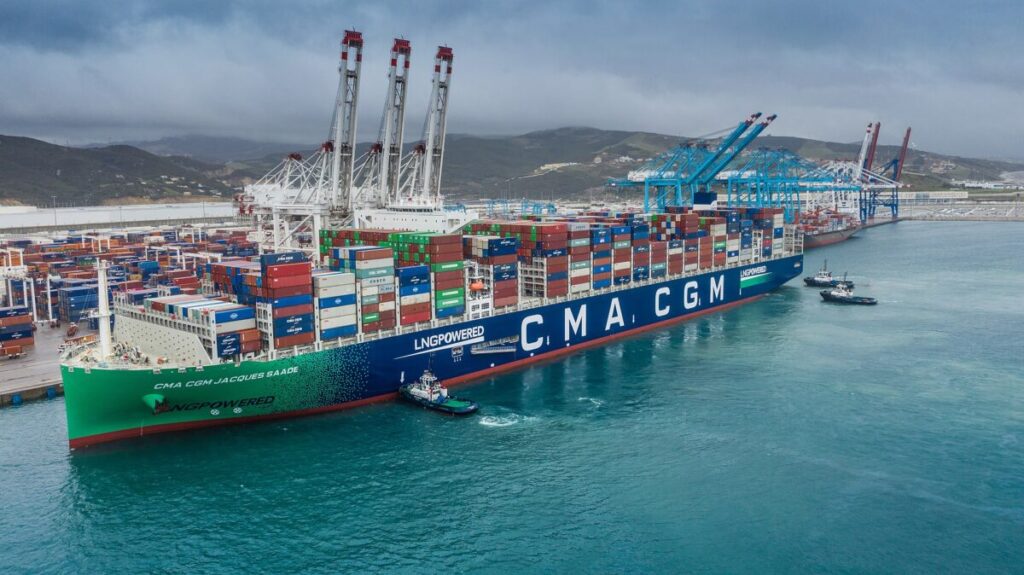
Featured Photo: The port of Tanger Med, open to the Strait of Gibraltar © CC BY-SA 4.0