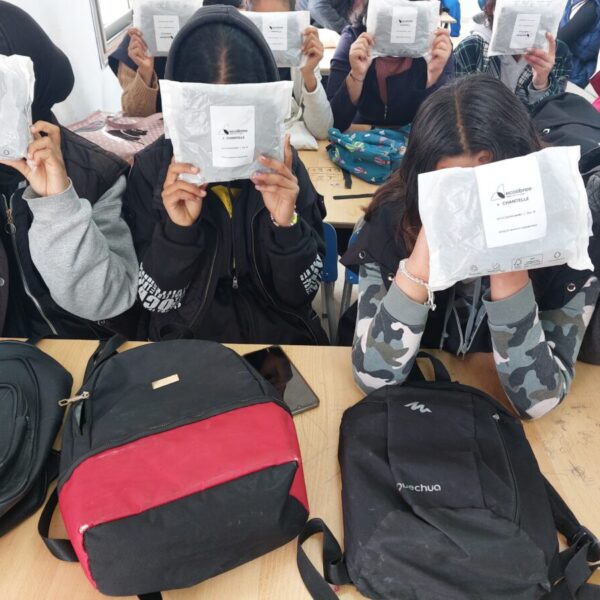
According to a 2023 report by the NGO Plan International, 500 million women and girls suffer from menstrual precarity worldwide. In Tunisia, no study on the subject is available. However, in this country, many young girls have to manage with pieces of fabric, or even mattress foam. The association Wallah We Can has decided to address this by distributing washable menstrual panties to students in need and by marketing them to humanitarian organizations.
Selling menstrual panties to international organizations to finance those offered to Tunisian schoolgirls is the idea of the NGO Wallah We Can. The project called Ecolibree was launched at the end of 2021. It is still in its early stages, but it has the advantage of addressing the issue of menstrual precarity in the long term while respecting the environment.
Inform and Empower
Close to 500 kits – including three menstrual panties – have been distributed so far in boarding schools in the interior regions of Tunisia. "Each time, we organize a workshop with an expert to inform the girls about their cycles, then we give them a questionnaire that will allow us to publish a report on this precarious situation in Tunisia, as there is no data available. Finally, we present the panties that we distribute to underprivileged students," explains Sahar Abid, project coordinator, who claims to be receiving a real interest from the students.
While menstruation is still considered a taboo, Sahar claims to have encountered few refusals from the school principals: "The supervisors, in particular, are eager. In boarding schools, they face the ignorance of the young girls and their lack of means. The most underprivileged use dirty fabrics that they then hide in closets or under beds after using them…" With an unemployment rate of 16.4% and a guaranteed minimum monthly salary of 360 Tunisian dinars or TND (109 euros), some families struggle to buy a pack of pads for more than 3 TND (0.9 euros) each month for each of their daughters. Some prefer not to go to school when they are menstruating. "If I have pads, I go to school, otherwise I use a fabric and stay at home. When I use fabric, my behavior changes, I leave blood stains on my chair, I don’t want to go to the board anymore…," explains a young girl.
From washable napkin to menstrual underwear
Wallah We Can was created in 2012 to rehabilitate a boarding school in Makthar. It was on this occasion that the association identified the problem. "We had to change all the mattresses because of scabies. And shortly after, we saw that these mattresses were damaged again: the girls were taking the foam to stuff their underwear," explains the founder of the NGO, Lotfi Hamadi. The entrepreneur immediately had an idea: to employ mothers to make washable sanitary towels. But Wallah We Can faced various problems: the quality of the production was not consistent, it became increasingly difficult to import cotton, and the beneficiaries complained that these towels did not hold well. After two years, the project was put on hold.
In 2021, Lotfi Hamadi signed a partnership with the French brand Chantelle, as part of CSR (Corporate Social Responsibility). Chantelle sells him menstrual underwear at cost price (around 6 euros, compared to 19 euros in stores) and he can resell them to international organizations to finance those that are offered in Tunisian schools.
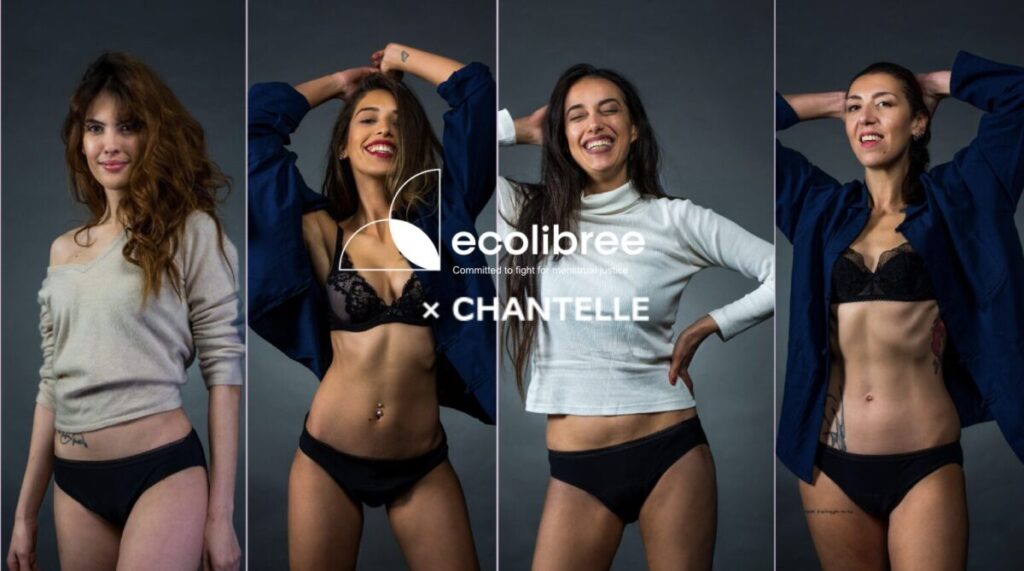
An ecological, ethical, and circular product
"This is a healthy solution. There are many organizations that claim to fight menstrual precarity by distributing disposable protections that are harmful to health, the environment, and are not a sustainable solution. We propose an ecological product," explains Lotfi Hamadi, who hopes to establish these underpants as a must-have in hygiene kits distributed in refugee camps, for example.
These underpants have many advantages. Providing twelve hours of protection, they are washable with cold water for those who do not have access to a water heater. Manufactured ethically, they allow, according to Wallah We Can’s calculations, to reduce the hygienic protection cost of 100 women by 70% over a period of three years. This also reduces waste.
However, the system is still struggling. Wallah We Can has so far only sold a few hundred underpants to two associations. On the other hand, the organization has received a grant from France to finance donations in Tunisian schools. But Lotfi Hamadi hopes to develop this circular economy by 2024. Especially since the project does not stop there: "In the long run, we hope to open our own workshops and manufacture these menstrual underpants ourselves."